The Signal
Technion Team Steers STM Electrons in 860-Attosecond Bursts
A Technion-led team used two-color infrared pulses to control electron flow through a scanning tunnelling microscope junction. The researchers report a theory-derived burst duration of 860 attoseconds, with 2-nanometer lateral resolution an
Quantum.world Team · Written with AI · fact-checked ·
Two laser colors turn a microscope current into a steering problem
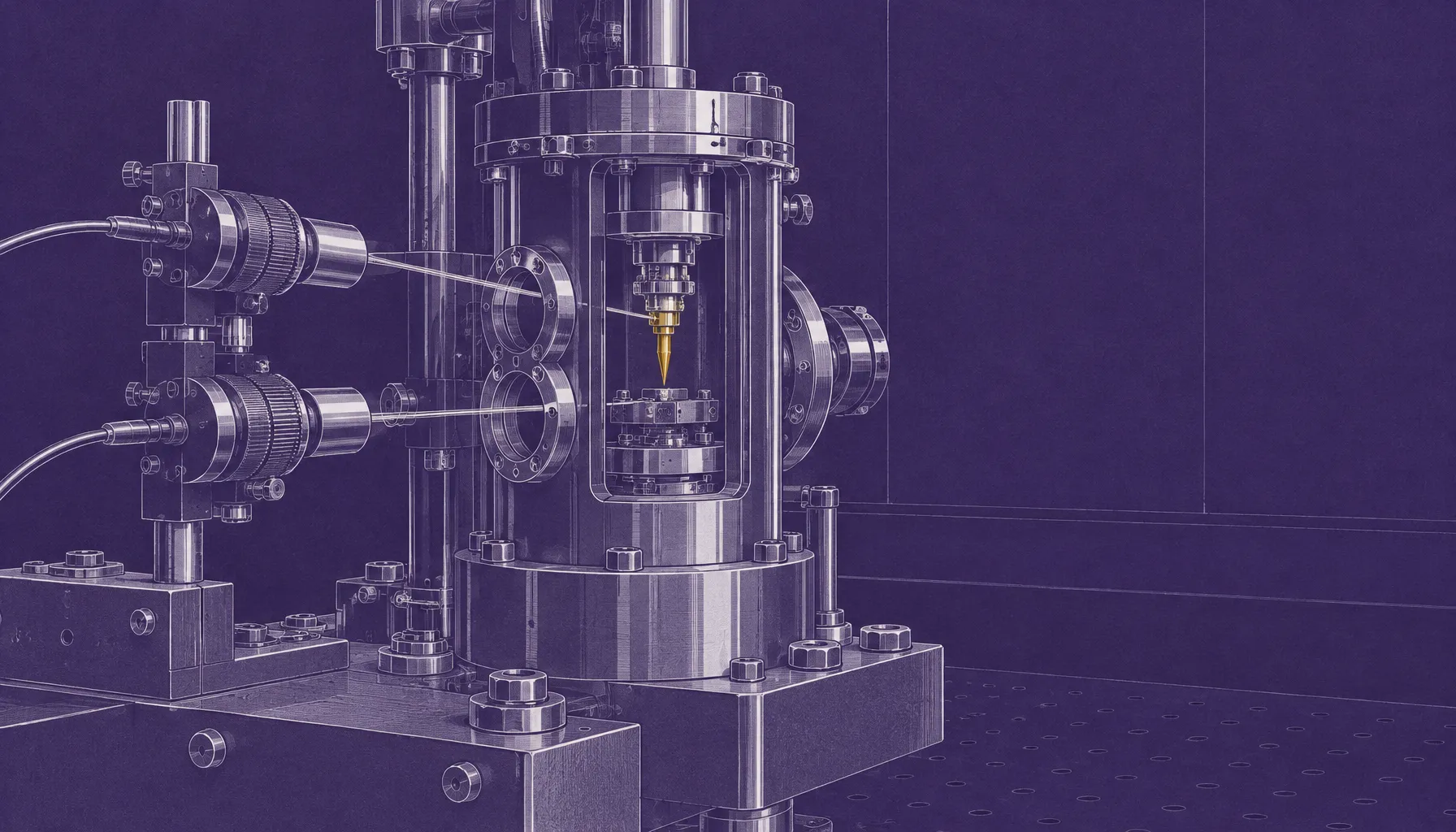
A scanning tunnelling microscope can map a surface atom by atom, but its usual current signal does not reveal how electrons move across the junction in real time. A Technion-led team reports controlling that flow in either direction by changing the timing of two infrared laser pulses. The group’s measurements and theoretical analysis indicate current bursts lasting 860 attoseconds, or less than a femtosecond.
The result, announced by Technion on October 22, addresses a practical obstacle as well as a timing one: laser heating can create signals that swamp the light-driven current researchers want to measure. Rather than switching the laser repeatedly on and off to separate signal from noise, the team varied the relative timing of the two colors. That timing changes the shape of the combined light wave and, in turn, the direction electrons travel between the microscope tip and sample.
Krüger says the team could control current direction
“We could finally prove without any doubt that we can control the direction of the current,” said Michael Krüger, a professor in the Technion Faculty of Physics, recalling a measurement brought to him by Daniel Davidovich, Boyang Ma and Adi Goldner. The team used a sharply pointed STM probe held close to a surface, where electrons cross the gap by quantum tunnelling. The laser field modifies that transfer, allowing the researchers to steer current from tip to sample or back again.
The 860-attosecond figure is not a direct stopwatch measurement of an isolated electron. Technion says researchers reconstructed the burst duration by comparing their measurements with several theoretical models; the paper’s abstract likewise describes the duration as theory-derived. The distinction matters: the experiment controls the direction of the measured current, while theory supplies the detailed duration of the underlying burst.
Two nanometers sideways, below an ångström in height
The microscope operated at room temperature and in air, according to Technion. It retained lateral resolution of about 2 nanometers and detected surface-height changes smaller than an ångström. Those are different measures of performance: the height sensitivity is finer than the sideways resolution, so the result should not be read as atomic-scale lateral imaging.
The authors describe a three-step transport process in the non-adiabatic tunnelling regime, where electrons do not simply follow the changing light field instantaneously. Their abstract says the team compared its measurements with one-electron and many-body theory descriptions to identify the mechanism and estimate the burst duration. That modeling links the observed current direction to the short-timescale dynamics in the junction.
Noise control took years of optical work
Adi Goldner, a staff scientist in Krüger’s lab, said the group tested three laser systems and repeatedly rebuilt the optical setup to distinguish the current from noise. The work also involved theoretical physicist Andrei Borisov, associated with CNRS Université Paris-Saclay and the Donostia International Physics Center. The research received support from the European Research Council’s ATTIDA project, the Israel Science Foundation and the Helen Diller Quantum Center at Technion.
Technion frames the method as a step toward triggering and imaging fast charge dynamics at selected locations in materials. The present result, however, demonstrates directional control in the STM’s nanoscale junction; using it to observe charge motion in other materials or to inform future electronics remains a research goal. The measured performance reported so far is specific: room-temperature operation in air, about 2 nanometers of lateral resolution and sub-ångström sensitivity to height.