The Signal
SpinHex Projects 10,000 Logical Qubits on a 2.6 cm² Chip
A SpinHex design study projects that a 2.6 cm² chip could host 10,000 logical spin qubits, assuming two-qubit gate errors of 0.01%. The proposed hexagonal architecture uses multielectron quantum dots as couplers, but its two-dimensional net
Quantum.world Team · Written with AI · fact-checked ·
SpinHex’s 2.6 cm² estimate depends on 99.99% gates
A 2.6-square-centimeter chip could host 10,000 logical qubits in the SpinHex design, according to a paper published October 29 in Physical Review Research. The estimate assumes two-qubit gate errors of 0.01%, equivalent to 99.99% fidelity, and includes room for routing, control electronics and components needed for universal computation. It is a modeled footprint, not a chip the researchers have built.
The paper proposes a hexagonal network of semiconductor spin qubits linked by multielectron quantum dots. Its authors—Rubén M. Otxoa, Josu Etxezarreta Martinez, Paul Schnabl, Javier Oliva del Moral, Normann Mertig, Charles Smith and Frederico Martins—describe SpinHex as a conceptual architecture for running surface codes. The work studies the design numerically, including how its extra operations affect error correction.
“Here, we propose a spin-qubit architecture based on spinless multielectron quantum dots that act as low-crosstalk couplers between a two-dimensional arrangement of spin qubits in a hexagonal lattice.”
Rubén M. Otxoa et al., “SpinHex: A low-crosstalk, spin-qubit architecture based on multielectron couplers”
Three-way couplers link quantum-dot chains
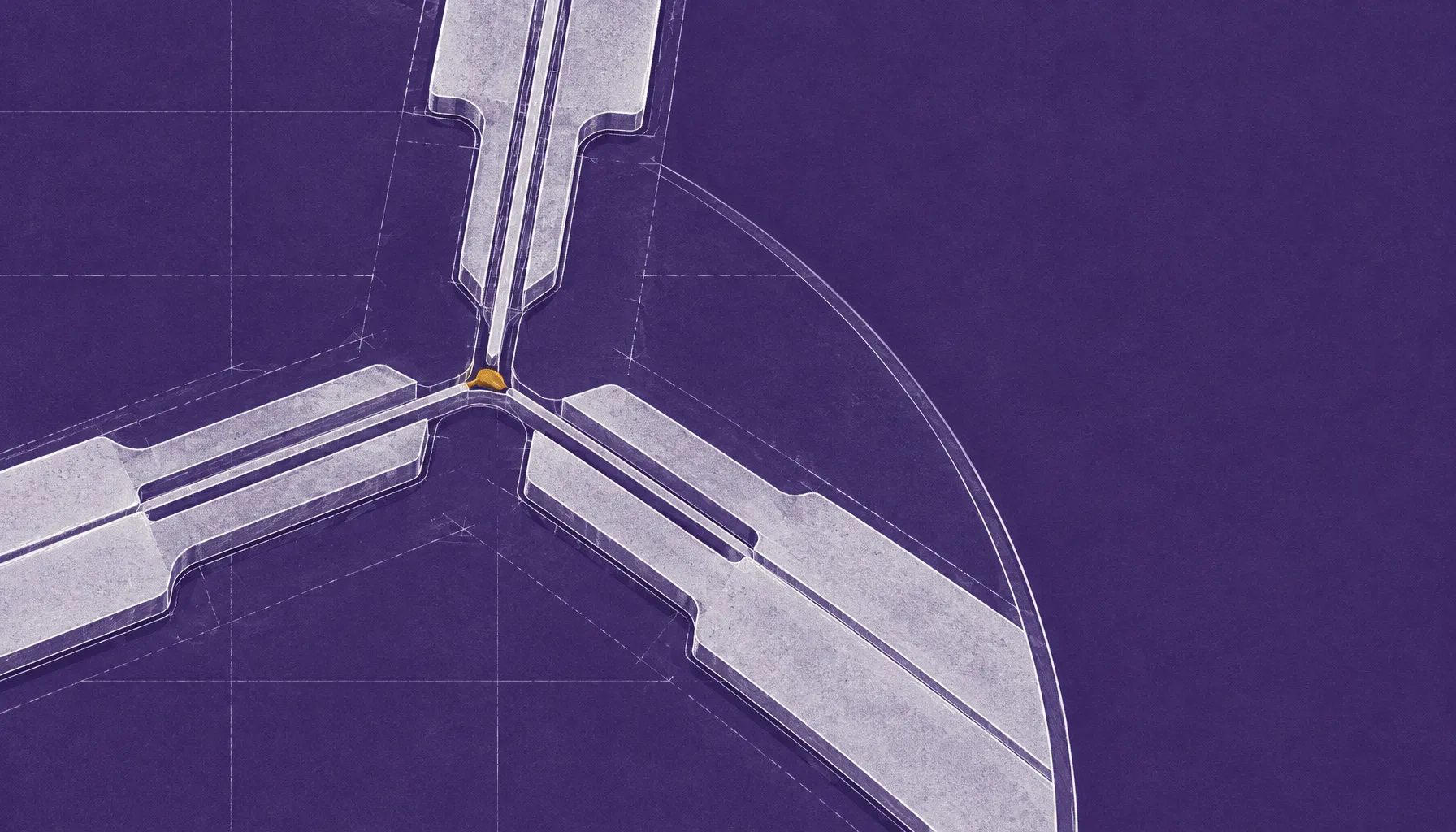
SpinHex joins one-dimensional quantum-dot arrays at three-way junctions to form a two-dimensional lattice. At each junction, a central dot containing roughly 50 to 100 charges acts as a coupler between neighboring spin qubits. Voltage signals control the coupler, which mediates Heisenberg exchange—the interaction used to carry out operations between spins.
The larger coupler is intended to keep qubit dots farther apart at junctions, reducing unwanted capacitive interactions between them. The design also separates data qubits from measurement qubits, which the authors say could reduce correlations in their charge-noise environments. The paper focuses on arrays of double quantum dots linked by these couplers, with spin information moved between locations through SWAP operations.
That movement comes with a cost: the extra SWAP gates add opportunities for errors during surface-code operations. The researchers simulated a rotated XZZX surface code using a circuit-level noise model and report a 0.18% threshold for entangling-gate errors in their minimal (2, 3) SpinHex layout. The threshold is an effective error-budget target, not a measured result from a SpinHex device; the model does not represent the microscopic noise of any one semiconductor platform.
The qubit count rises sharply when gates fall short
At the assumed 0.01% two-qubit error rate, the authors estimate about 4,480 physical qubits for one logical qubit operating in the TeraQuop regime, defined in the paper as a trillion error-free logical operations. The 10,000-logical-qubit chip estimate uses that same high-fidelity scenario. At a 0.05% error rate, about 4,480 physical qubits instead reach the lower MegaQuop regime; at 0.1%, the authors estimate more than 24,000 physical qubits just to reach MegaQuop.
The contrast makes gate performance central to the footprint projection. The paper says its TeraQuop estimate requires 99.99% fidelity for SWAP and other two-qubit gates, 99.999% for Hadamard gates, and 99.98% for state preparation and measurement. It notes that those targets have yet to be achieved for spin qubits. The 2.6 cm² estimate also relies on assumptions about dot and coupler dimensions and reserves additional area beyond the data blocks for control and routing.
A two-dimensional device is the outstanding test
The building blocks have different levels of experimental support. The paper cites demonstrations of multielectron-mediated exchange in one-dimensional devices and separately demonstrated spin-qubit devices in planar geometries, but says a full two-dimensional network of multielectron couplers has not been realized. Adapting the design to silicon platforms may require changes to the gate layout, while some silicon devices also need micromagnets or microwave antennas for spin control.
The authors identify a three-port coupler with independently tunable connections to multiple spins as a concrete milestone. Researchers would then need to measure capacitive crosstalk and noise during mediated exchange operations. Until those tests establish how the couplers behave in a two-dimensional array—and whether the required gate fidelities are reachable—the headline chip area remains an architectural estimate.