The Signal
Southeast University Team Demonstrates Quantum Mpemba Effect in a Qubit
A team at Southeast University used a controllable optical experiment to simulate a quantum thermal-relaxation map and demonstrate a strong Mpemba effect in a single qubit. Their approach removes coherence from the initial state to bypass t
Quantum.world Team · Written with AI · fact-checked ·
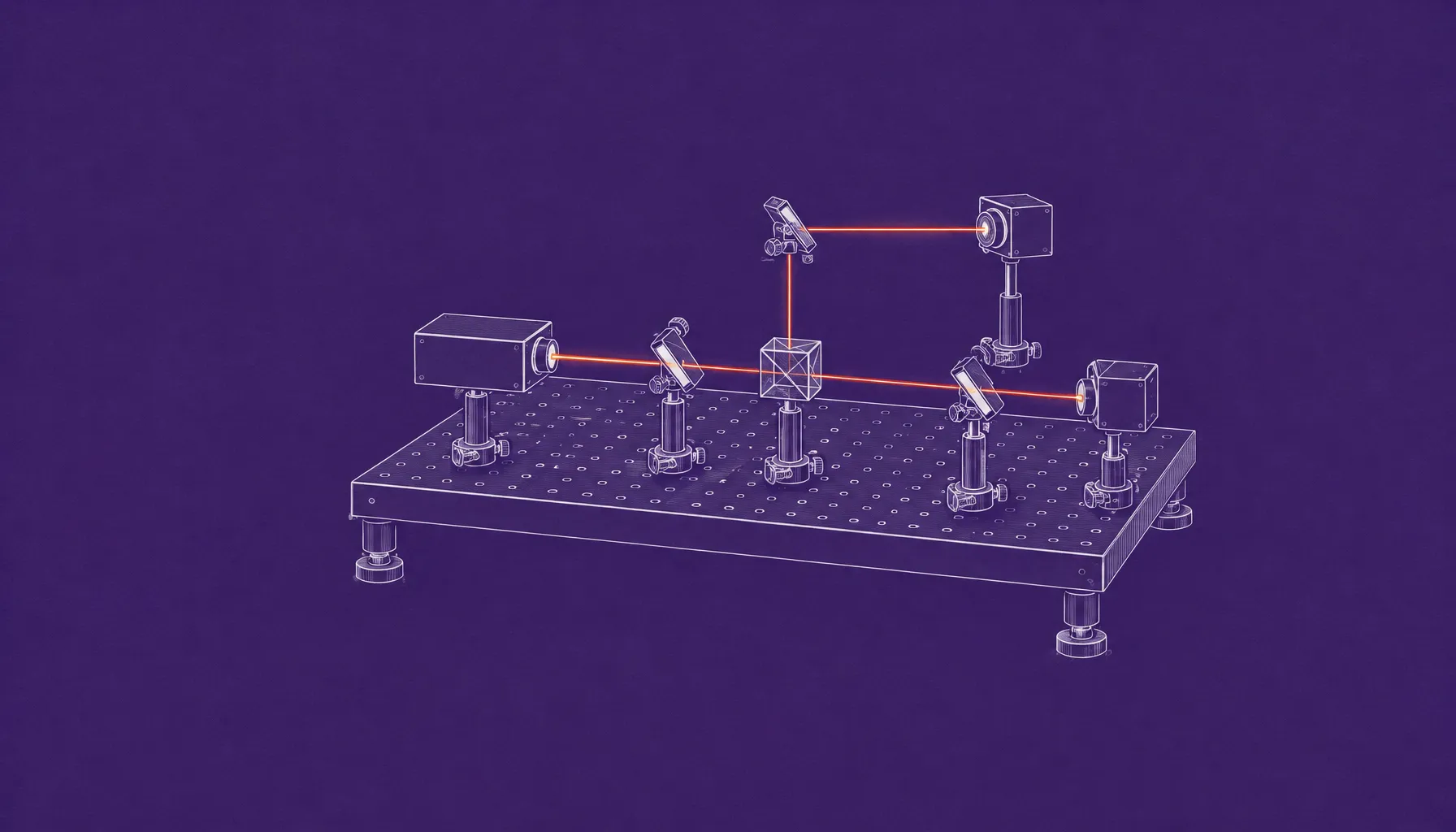
A single qubit is enough to demonstrate a quantum version of the strong Mpemba effect, according to a new experiment published in Physical Review Letters on October 22. Researchers Xiang Zhan, Huixia Gao, Lei Xiao and Peng Xue of Southeast University used a controllable optical setup to simulate a quantum thermal-relaxation process, then prepared an initial state whose coherence could be removed to speed its approach to equilibrium.
The result turns on a counterintuitive feature of the model: its slowest-decaying modes are degenerate and purely coherent. Eliminating coherence from the initial state can therefore suppress those slow modes, allowing the remaining dynamics to relax more quickly. The team verified that its simulated process obeyed the semigroup property, a consistency condition for the evolution.
A faster route past the slow modes
In the ordinary Mpemba effect, a system that starts farther from equilibrium can reach equilibrium sooner than one that starts closer. The strong version concerns the long-time decay: a specially prepared state avoids the slowest mode, so its later relaxation is governed by faster modes instead.
That condition is often associated with a unique slowest-decaying mode. The Southeast University team studies the Davies map, where the slowest modes are degenerate and purely coherent. The authors’ proposed route is to eliminate coherence in the initial state, rather than rely on the usual requirement of a single slowest mode.
“We further demonstrate a genuine quantum strong Mpemba effect in the minimal quantum system, a single qubit,” the authors write in the paper’s abstract. The experiment supports their claim that coherence plays a defining role in this form of anomalous thermal relaxation.
What the optical experiment establishes
The experiment simulates the Davies map with a fully controllable optical setup; it does not describe a naturally cooling qubit in an uncontrolled environment. The researchers say they confirmed the map’s validity by checking the semigroup property, which tests whether successive stages of the simulated evolution compose consistently with the same dynamics.
That distinction matters when interpreting the result. The paper demonstrates a designed and verified quantum-dynamics model in a one-qubit system, not a general method for accelerating the thermalization of working quantum processors. Its immediate contribution is experimental evidence for a specific mechanism linking coherence and relaxation speed.
A new mechanism, not the first quantum Mpemba observation
The finding adds a different approach to earlier experimental work. A 2025 Nature Communications study reported a strong quantum Mpemba effect in a single trapped ion, preparing a state with no overlap with the slowest-decaying mode. The new experiment instead focuses on the Davies map’s coherent, degenerate slow modes and on suppressing them by eliminating coherence.
The authors describe their optical setup as a platform for studying quantum thermodynamics and other open-system dynamics. Whether the same coherence-based strategy can be carried into more complex systems is not established by the single-qubit demonstration. For now, the measured result is a faster relaxation route in an optical simulation of the Davies map, demonstrated with one qubit.
Xiang Zhan, Huixia Gao, Lei Xiao and Peng Xue, Southeast University