The Signal
Rydberg-Atom Receiver Shows 210 MHz Bandwidth—with a Caveat
A Rydberg-atom receiver demonstrated a 210 MHz frequency span using a microwave frequency comb and a position-dependent Stark field. The full-band measurements used one vapor cell at a time; a separate two-cell test showed reception across
Quantum.world Team · Written with AI · fact-checked ·
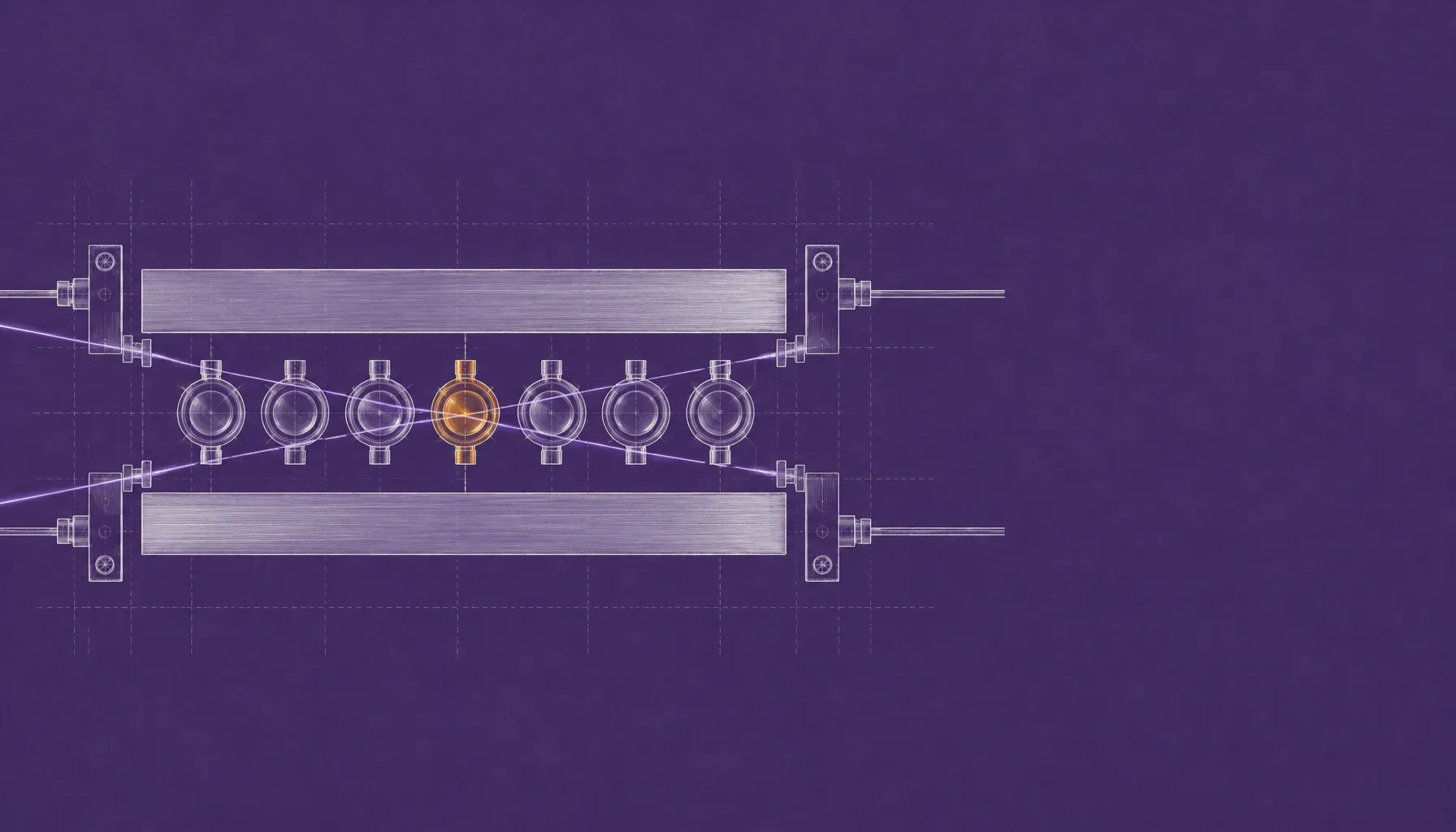
The receiver’s headline bandwidth is 210 MHz; its full-band demonstration did not yet use 21 channels operating in parallel. In a paper published November 1 in Communications Physics, Yuechun Jiao and colleagues report a Rydberg-atom microwave receiver built around a frequency comb and a position-dependent electric field. The researchers measured channels one at a time, then used two cells to test reception across part of the band. The authors say continuous, simultaneous operation over the whole span requires parallel implementation and readout of all channels.
A Stark shift assigns each cell a frequency
Rydberg atoms can detect microwave fields through changes in their energy levels, read out optically. But the instantaneous bandwidth of a receiver based on a single vapor cell is constrained by atomic coherence. Jiao’s team addresses that limit by pairing a microwave frequency comb with a spatially varying Stark field, which shifts the resonant transition frequency according to a cell’s position.
Each comb line can serve as a local oscillator for a cell tuned to that line. The incoming microwave signal mixes with the local oscillator in the atoms, producing a beat note that the researchers read from the transmitted probe light. Multiple cells set at different positions can therefore cover neighboring frequency intervals; the proposed bandwidth grows with the number of cells and comb lines.
Twenty-one channels span 210 MHz
For the proof-of-principle measurements, the team used a comb with 21 frequency lines, spaced 10 MHz apart around a center frequency of 8.13 GHz. A single cell’s measured instantaneous bandwidth was about 10 MHz, or ±5 MHz. Taken together, the channel measurements covered 8.025 to 8.235 GHz, a 210 MHz span under the paper’s 3 dB bandwidth definition.
The team generated the Stark-field gradient with a 120 MHz radio-frequency field applied to aluminum electrode plates. Rather than use a 21-cell array for those measurements, the researchers changed the electrodes’ position relative to a single vapor cell at 21 positions, then combined the measurements. The paper reports an overall sensitivity of 326.6 nV cm−1 Hz−1/2 across the tuning range; sensitivity worsened as the transition frequency was shifted higher.
Two cells test reception; 21-cell operation remains ahead
A separate test placed two cells at opposite ends of the Stark field, tuned to microwave frequencies of 8.03 and 8.23 GHz. The researchers swept a signal from 8.02 to 8.24 GHz and observed beat-note responses from both cells. That test supports the multi-cell approach, but it does not establish continuous, simultaneous readout of all 21 channels across the full bandwidth.
“Full simultaneous operation across the 210 MHz bandwidth requires parallel implementation and readout of all channels.”
Yuechun Jiao and co-authors, authors of the Communications Physics paper
The distinction matters for proposed uses such as broadband monitoring and communications: a stitched measurement demonstrates frequency coverage, while a receiver tracking signals across the entire band at once needs multiple cells and parallel readout. The paper also identifies the microwave comb generator’s available power as a practical limit on the number of lines. The authors propose integrating 21 vapor cells for continuous reception, but that full array is not the configuration used for the reported 210 MHz channel-by-channel characterization.
Bandwidth scales with hardware
The architecture trades a narrow response in each cell for a wider combined range across a spatially arranged set. Adding channels could extend the span, provided the system supplies enough comb lines and power and produces the required Stark-field profile. The result establishes a 210 MHz proof of principle, with the next step being parallel operation of the 21 channels rather than another stitched sweep.