The Signal
Roth Team Maps Arbitrary Atom Rearrangements onto Optical Lattices
Alexander Roth and colleagues propose a coherent scheme for rearranging ultracold atoms in optical lattices using global tunneling pulses and local phase shifts. Their two-dimensional routing protocol scales in circuit depth as the square r
Quantum.world Team · Written with AI · fact-checked ·
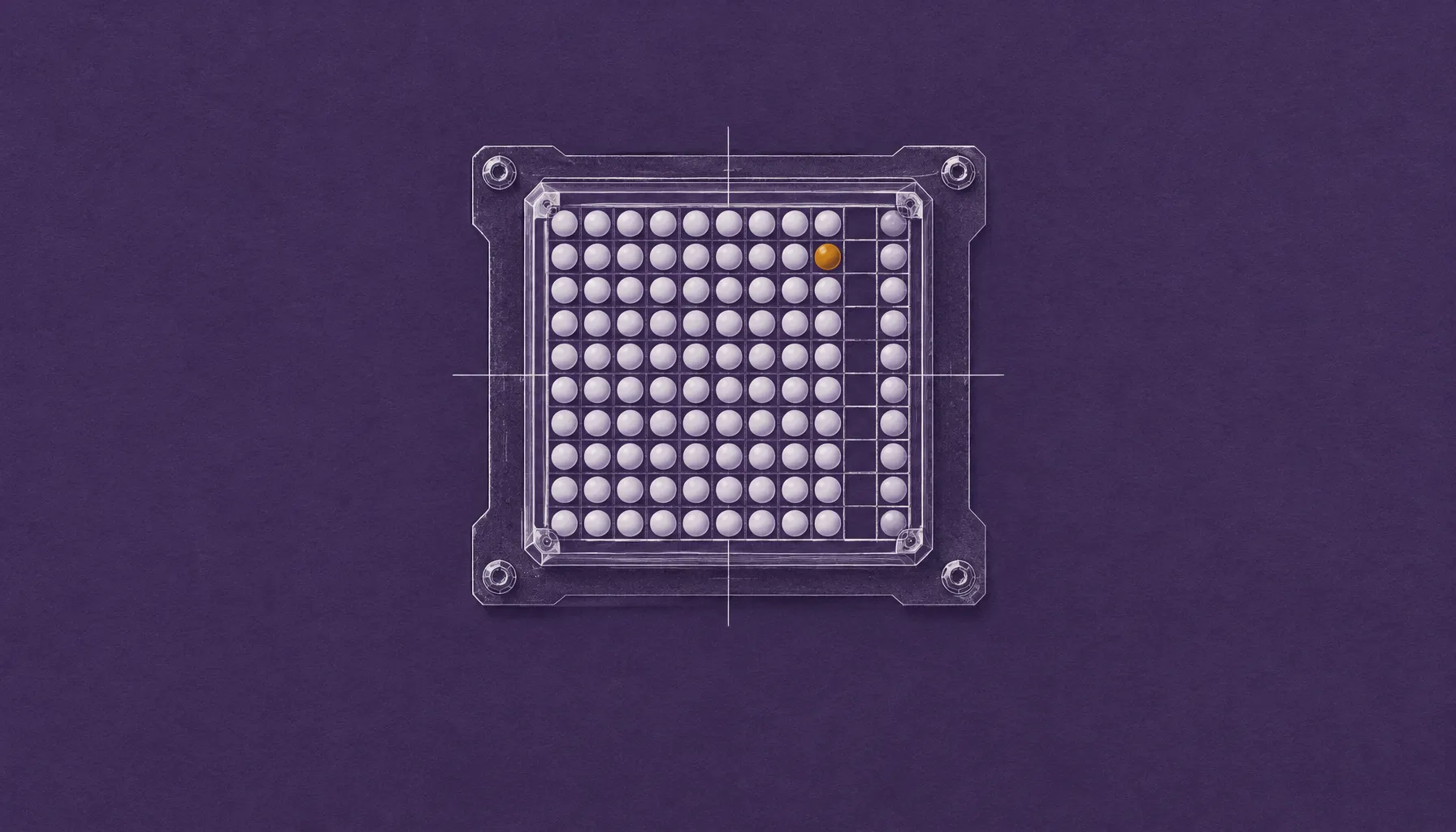
Mobile optical tweezers can move atoms one by one, while recent parallel methods address short-range rearrangements. Alexander Roth and colleagues propose a different route for optical lattices: a coherent protocol that can route atoms between arbitrary sites in two dimensions with circuit depth proportional to the square root of the number of sites. The catch is that their result is a theoretical design, not a demonstrated atom-sorting experiment, and it depends on precise local control inside a lattice.
The paper, published in PRX Quantum on October 30, 2026, adapts a method used to program optical interferometers to the motion of ultracold atoms. The authors write: “In this work, we present a framework for decomposing arbitrary N-dimensional single-particle motional unitaries into native local gates for quantum simulators based on optical superlattices.” The approach aims to turn a lattice’s ordinary tunneling and site-level energy shifts into a programmable sequence of operations.
From serial tweezer moves to parallel lattice gates
In common tweezer-based rearrangement, movable traps carry individual atoms or groups of atoms to their destinations. The paper notes that these moves are typically performed serially, though parallel, constant-time protocols have been demonstrated for short-range rearrangement. The new proposal targets a different task: arbitrary permutations across a two-dimensional array, including cases where atoms must avoid collisions while changing rows and columns.
Its building blocks are two-site operations in a superlattice made from overlapping lattices with different periodicities. A tunneling pulse mixes the atom’s motional state between the two wells of a double well; a site-resolved potential shift adds a local phase. The researchers map these operations onto the Clements decomposition, a sequence for constructing arbitrary transformations across optical modes. Tunneling is controlled globally, while local addressing supplies the phase operations.
Three passes route atoms across a square array
For one-dimensional rearrangement, the scheme combines parallel identity and swap operations into a network of gates. In two dimensions, the authors introduce a horizontal-vertical-horizontal routing sequence. The first horizontal pass moves atoms into temporary positions, the vertical pass sorts them into target rows, and a final horizontal pass places them in their destination columns.
Temporary buffer columns prevent two atoms from being sent to the same site during the vertical pass. In the worst case, an array with side length L requires L−1 extra columns, making the temporary width as large as 2L−1. Simulations of random target arrangements found that typical buffer needs were much smaller than this worst case. The resulting circuit has depth of order √N for N sites, rather than the order-N number of moves associated with serial rearrangement.
The speedup is a circuit-depth comparison, not a measured runtime advantage over an operating tweezer system. It also assumes the lattice can carry out the required gates while preserving coherent motion. The protocol uses lowest-band dynamics and applies to bosons and fermions, but it is designed for non-interacting particles or weak residual interactions; stronger interactions break the single-particle optical analogy.
Local addressing sets the experimental bar
The paper’s numerical analysis tests sensitivity to intensity noise, crosstalk from addressing beams, and residual atom interactions. Its error estimates put tight demands on local phase control: for the modeled transformations, crosstalk and phase errors must be kept near the 10−3 level to reach the stated high-fidelity target. Those are calculated thresholds, not experimental performance measurements for this rearrangement sequence.
The authors estimate that a 10-mode discrete Fourier transform would take about 6 milliseconds under their proposed lithium-atom implementation parameters, compared with motional coherence times of tens of milliseconds reported for relevant lattice systems. Scaling to larger arrays would require longer coherence and control across a much wider lattice. The paper also identifies static variation in tunneling across large arrays, caused by the lattice-beam profile, as a significant scaling issue.
Rearrangement is one use of the same control scheme
The Clements-based gate sequence is intended to do more than move atoms. The authors also propose using it to implement a discrete Fourier transform within the lattice, coherently converting between position and momentum modes, and to synthesize dynamics from Hamiltonians whose terms are not native to the lattice. Those operations could support momentum-space measurements and quantum simulations, though each depends on the same finely calibrated tunneling and site-resolved phase control.
The immediate test is experimental: whether a lattice system can maintain the required phase precision and coherence across a full routing sequence. Until then, the paper establishes a compilation method and a calculated scaling advantage over serial routing, not a replacement for demonstrated tweezer assembly.