The Signal
RIT Researchers Model Faster Weak-Force Detection at an Exceptional Point
A theoretical optomechanical model finds that a weak mechanical force can be detected with the same reliability in less observation time at an exceptional point than in a comparable reference system. The estimated 49.85% time reduction assu
Quantum.world Team · Written with AI · fact-checked ·
A modeled cut of nearly half
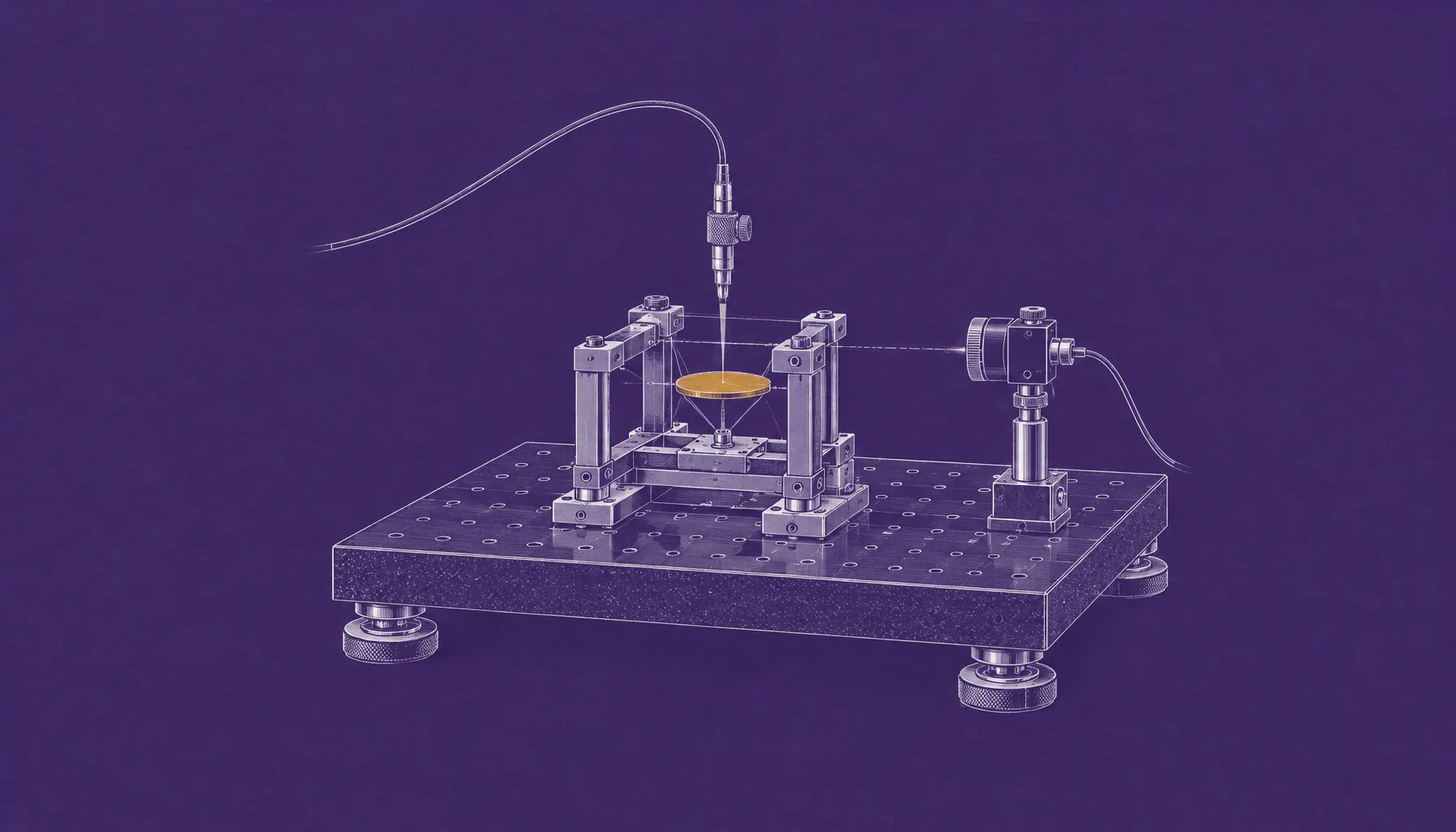
A modeled optomechanical sensor detects a weak mechanical force in about half the time of a comparable sensor without an exceptional point. In a calculation by Rochester Institute of Technology researchers Aritra Ghosh and M. Bhattacharya, the exceptional-point system reaches the same detection reliability with approximately 49.85% less observation time—assuming ideal collection of the light leaving its cavity.
The result is theoretical, not a report of a built sensor or laboratory measurement. The arXiv page dates the paper October 27, 2026. It compares an optomechanical model with a reference oscillator matched for decay rate and signal variance. The authors frame detection as a decision: determine whether a weak force is present or absent, with both possibilities equally likely.
By choosing a weak mechanical force as the perturbation to detect, we show that optimal measurements of the ideally collected cavity output require approximately 49.85% less observation time than an ideally observed non-EP reference oscillator to reach the same detection reliability.
Aritra Ghosh and M. Bhattacharya, the paper’s authors, write
Detection and spectral splitting
An exceptional point, or EP, is a non-Hermitian degeneracy where both eigenvalues and eigenvectors coalesce. A small generic perturbation can split the coalesced eigenvalues sharply, a response that has made EPs attractive for sensing. But a visible or measurable split does not by itself mean a sensor can reliably identify a weak signal quickly.
For the finite-dimensional, open systems covered by their general analysis, the researchers find that reliable detection of a weakening generic perturbation still takes observation time that grows at least as the inverse square of its strength. On the shorter timescale associated with the EP’s spectral splitting, even the best possible measurement approaches a 50% correct-decision rate—the same as guessing between two equally likely options. The paper’s central distinction is between an enhanced spectral response and the information a measurement actually collects.
Why the mechanical signal gains
In the optomechanical example, a resonant force with a known phase acts on the mechanical mode and changes the light emitted by the optical cavity. The model places the coupled optical and mechanical modes at a second-order exceptional point, where their decay modes coalesce. In this case, the force changes the modes’ mean amplitudes but does not split the exceptional-point eigenvalues.
The advantage depends on the signal being measured. The mechanical-force perturbation raises the model’s quantum Fisher information rate, a measure of how quickly measurements can distinguish force-present from force-absent cases. A separately modeled optical-drive perturbation lowers that rate instead. The exceptional point therefore does not give every weak signal a faster readout; the researchers’ result depends on selecting a perturbation that benefits from the system’s decay dynamics.
Ideal collection sets the limit
For the cavity-output comparison, the paper assumes a 6.0 MHz optical linewidth, a 3.6 kHz mechanical linewidth and 100% collection of cavity emission. With those illustrative parameters, its weak-force-limit calculation gives an observation-time ratio of about 0.5015 for the exceptional-point sensor relative to the reference. For a modeled force amplitude of 1,000 s-1 and a target 90% probability of a correct decision, the estimated times are approximately 2.42 seconds at the exceptional point and 4.82 seconds for the reference.
Those figures depend on the assumed collection efficiency and optimal measurement; they are not device test results. The paper’s formula says the cavity output reaches the target sooner only when the relative information-rate factor, ηu2(1+u), exceeds one, where η represents the collected fraction of cavity emission and u is set by the model’s coupling and decay rates. The 49.85% reduction uses η=1, making collection losses a direct constraint on the claimed time advantage.