The Signal
QSolid Tests Its 30-Qubit Processor as 10-Qubit System Opens Access
Germany’s QSolid consortium says it is testing a 30-qubit quantum processor, while its previously tested 10-qubit system has already been made available to users. The €76.3 million project reports fast-gate and hardware-integration advances
Quantum.world Team · Written with AI · fact-checked ·
The 30-qubit system is still in testing
QSolid’s 30-qubit processor is not yet the system users can access: the consortium says it is testing the larger machine, while its tested 10-qubit system has already been made available to users. Fraunhofer IPMS announced the distinction on October 23, describing the 30-qubit tests as producing “promising results.” The release does not provide a measured error rate, gate fidelity or benchmark score for the larger processor.
That gap matters because QSolid’s stated goal was a 30-qubit chip with low error rates. The consortium says it has produced several demonstrators and more than met that goal, but the public update stops short of showing performance data that would let readers assess the 30-qubit processor against other systems. The 10-qubit machine, by contrast, has reached testing and user access.
Fast gates, without a published benchmark
The project identifies a particularly fast quantum gate as one of its technical achievements, saying its switching speed sets new international benchmarks. It does not give a gate time or fidelity in the October 23 release. Project coordinator Prof. Frank Wilhelm-Mauch of Forschungszentrum Jülich describes the trade-off behind that work: “The performance of a quantum computer depends on how many computational steps it can carry out while keeping errors to a minimum.”
He says researchers can pursue longer-lived qubit states or faster gate operations to fit more computational steps into the time available. Faster gates alone do not establish useful system performance: the processor also needs errors low enough to preserve results across those operations. The release offers no figures for the 30-qubit system on either measure.
Interposers link the quantum chip to control electronics
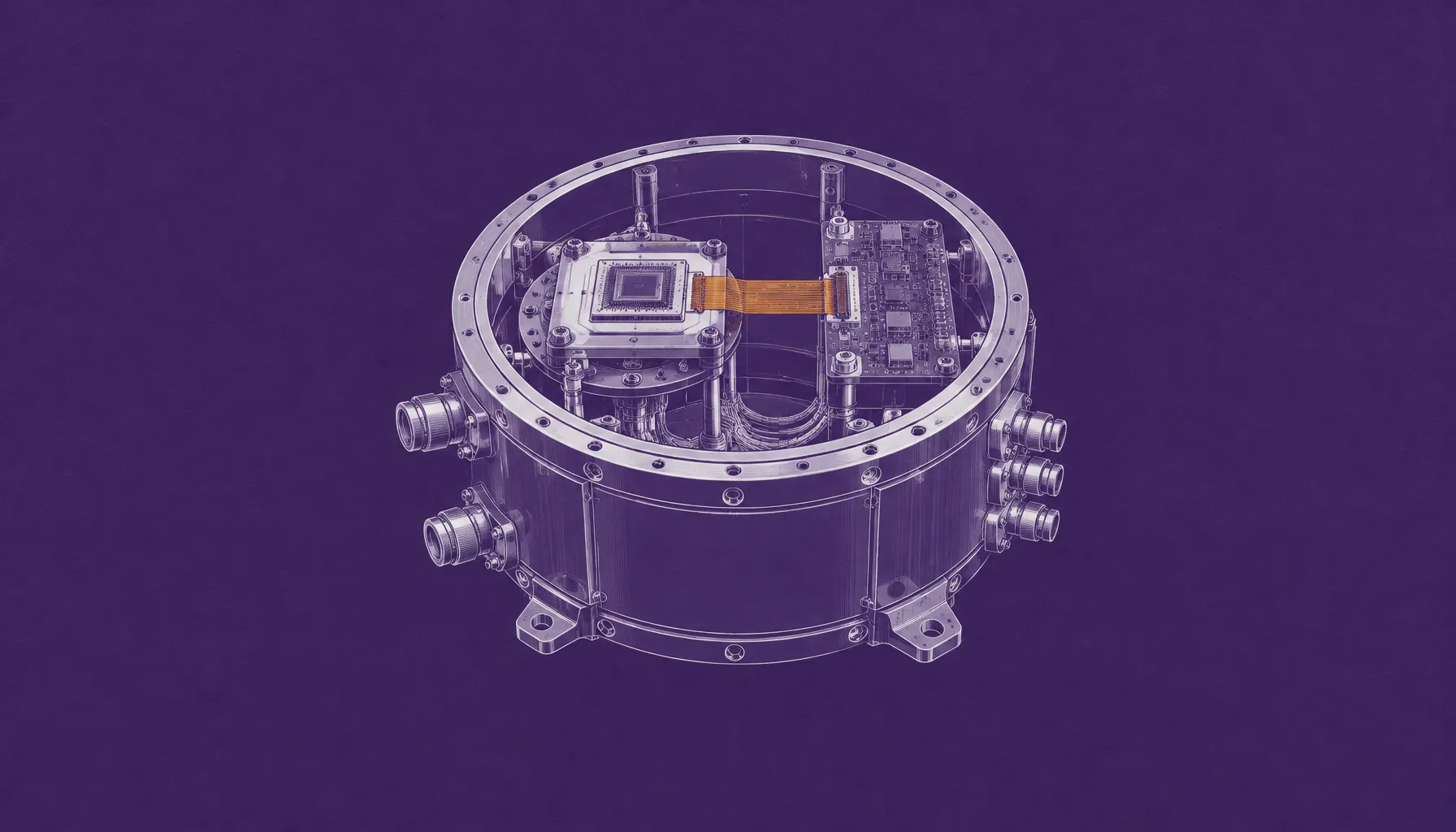
Fraunhofer IPMS worked with GlobalFoundries on cryogenic characterization of CMOS circuits and with Fraunhofer IZM-ASSID on advanced packaging. The package uses an interposer to connect the quantum chip and control chip in a compact arrangement. The engineering challenge is to transmit control and readout signals while limiting heat reaching the sensitive quantum hardware.
That work draws on semiconductor manufacturing processes rather than treating the processor as a stand-alone chip. The consortium’s account presents cryogenic electronics and packaging as part of the route to larger processors, but it does not report a qubit count beyond the 30-qubit system now under test or quantify how much the packaging improves performance.
Applications test hardware and software together
QSolid used demonstration applications to examine how the hardware and software work together under realistic conditions. One example models spin-resonance processes used in chemical analysis and magnetic resonance imaging. The project’s software stack combines components from Zurich Instruments, Qruise, Bull, ParityQC and HQS Quantum Simulations, alongside connectors from Rosenberger and cables from Supracon.
The consortium brings together 26 research institutions, companies and start-ups. Its €76.3 million project runs from January 2022 through December 2026; Fraunhofer says 89.8% of the budget comes from Germany’s Federal Ministry of Research, Technology and Space. The partner mix spans processor development, packaging, control systems and software, reflecting the amount of integration required to operate a quantum computer beyond a laboratory chip.
Jülich’s closing event comes next week
Project participants are scheduled to meet in Jülich from October 27 to 29 to present results and discuss lessons from the collaboration. Forschungszentrum Jülich’s account also points to a practical outcome beyond the processor: HQS Quantum Simulations says work on nuclear magnetic resonance led to a product for materials analysis that is already delivering value to users.
For the 30-qubit machine, the next concrete test is whether the consortium publishes performance data alongside its promising-results description. Until then, the clearest public distinction is between a 10-qubit system already tested and accessible to users and a 30-qubit system that remains under test.