The Signal
QMatter Team Runs 52-Qubit Chemistry in a Million-Atom Protein Model
A preprint describes a hybrid simulation of ADGRG1 autoproteolysis in a model containing 1,173,254 atoms, with quantum calculations focused on the reaction site. Its reported barriers closely match a classical benchmark, while the authors n
Quantum.world Team · Written with AI · fact-checked ·
A hybrid simulation by QMatter and its collaborators models a protein reaction inside a model containing 1,173,254 atoms. The study examines ADGRG1, an adhesion G-protein-coupled receptor that cuts one of its own peptide bonds. Its quantum calculation used 52 qubits on IQM’s 54-qubit processor, while classical methods modeled the receptor’s wider environment.
The work puts a small quantum calculation inside a much larger biological model—not by treating every atom quantum mechanically, but by assigning different computational methods to different regions. The preprint, by Alexander Orlov and 13 co-authors, appeared on arXiv on October 16.
ADGRG1’s cleavage site sits in a membrane model
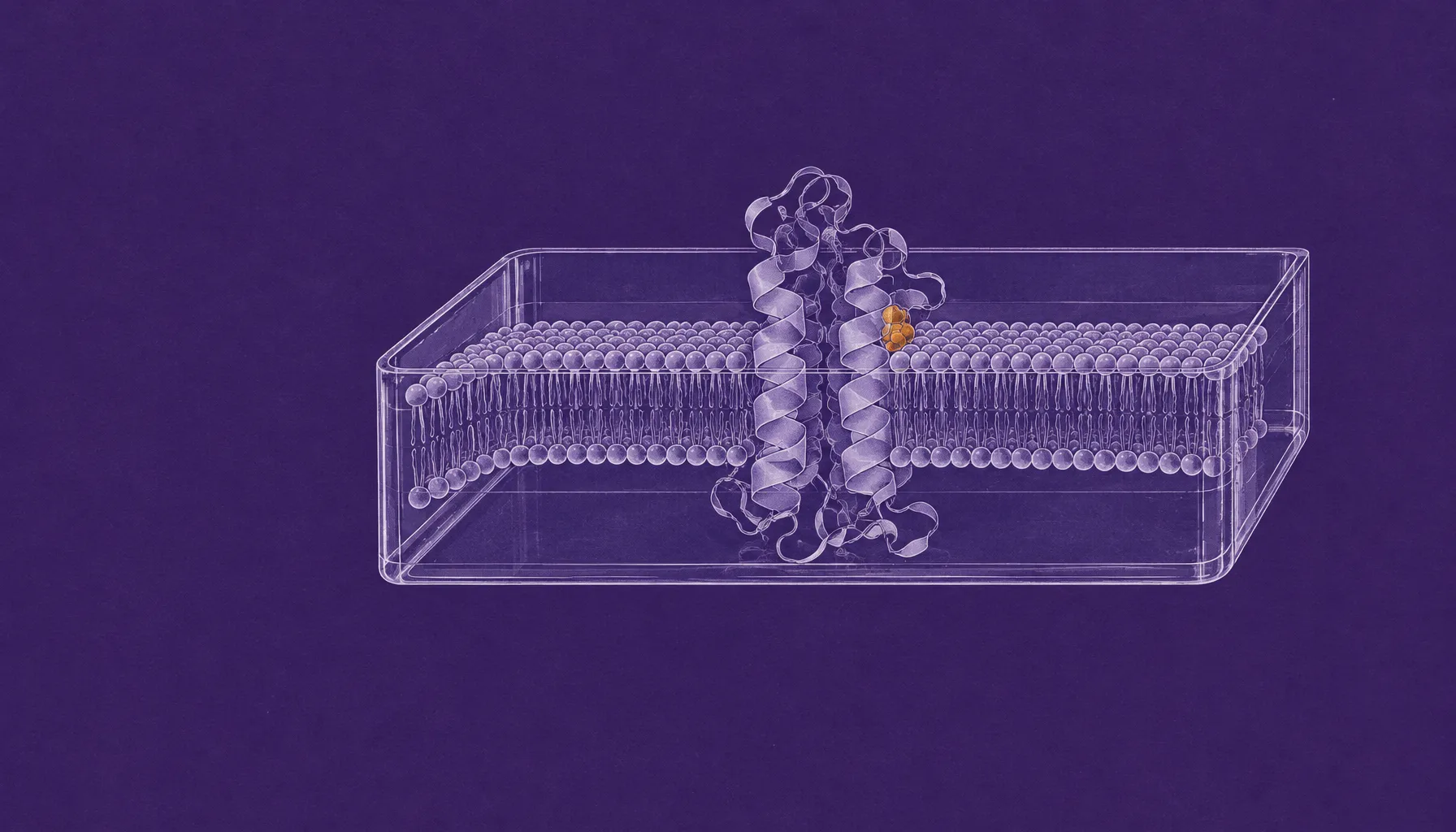
ADGRG1 belongs to the adhesion GPCR family. In autoproteolysis, a protein cleaves its own backbone without an external enzyme. The researchers modeled the full-length, uncleaved human receptor in a membrane-and-solvent environment designed to represent the endoplasmic reticulum, where the cleavage is thought to occur.
The model combines a computationally predicted receptor structure with an experimentally determined transmembrane structure. Molecular-dynamics simulations sampled the receptor’s motion; the team then reconstructed the reaction pathway with quantum mechanics/molecular mechanics calculations. The system’s 1,173,254 atoms include 10,463 in the receptor, 131,730 in the membrane, more than 1 million water atoms and 1,992 ions.
Only the reactive center went onto the QPU
The workflow narrows the calculation as it approaches the bond-breaking chemistry. Researchers treated a 163-atom region around the cleavage site with density-functional theory, then embedded a 26-electron, 26-orbital active space in that surrounding calculation. Mapping its 52 spin orbitals to 52 qubits left two of the IQM processor’s 54 qubits unused.
The quantum method, iterative quantum-selected configuration interaction, samples electronic configurations on the processor and uses classical computation to evaluate their energies. The iterative loop feeds information from each classical solution back into later quantum sampling. The team ran the workflow through CUDA-Q in the computing environment at the Leibniz Supercomputing Centre; GPU post-processing scaled to 1,200 NVIDIA H100 GPUs.
The result tracks a classical benchmark
The correlated calculation changed the predicted reaction energetics. The study reports that one density-functional calculation put the first-step barrier at 36.5 kilocalories per mole, while a mean-field treatment gave 14.0. The correlated treatment lowered the overall electronic barrier from 55.4 to 51.9 kilocalories per mole and restored the intermediate ordering found by the mean-field calculation.
For the three reaction structures, the quantum-selected calculation produced barriers of 25.9, 28.3 and 52.1 kilocalories per mole relative to the reactant. Extrapolated heat-bath configuration interaction, a classical benchmark, gave 25.5, 27.5 and 51.9. The close agreement shows that the hybrid workflow reproduced the benchmark for this case; it does not show that the quantum processor outperformed classical methods.
“We note that all WF-in-DFT-in-MD energies reported here are evaluated as single-point calculations on geometries obtained from the DFT-based QM/MM pathway reconstruction.”
Alexander Orlov and co-authors, authors of the paper, write in “Multiscale Quantum-Classical Simulation of Protein Autoproteolysis in a Million-Atom Membrane Environment.”
A realistic setting, with limits on the calculation
The authors describe the reaction as weakly correlated, a case where classical HCI performs well. The quantum sampling did recover higher-order electron configurations, but those configurations contributed little to the energy in this system. The paper presents their recovery as a reason to test the method on reactions with stronger electron correlation, not as evidence of an advantage in the ADGRG1 results.
The energy profiles also have a defined methodological limit: the correlated calculations were single-point evaluations on structures generated along a density-functional reaction pathway, rather than fully relaxed profiles at each level of theory. The study therefore demonstrates a way to connect quantum hardware to a large biomolecular workflow, while its reported barriers remain tied to that pathway and to a benchmark classical methods already match closely.