The Signal
PASQAL’s Rydberg Array Maps Ising Meson Spectra
A team affiliated with PASQAL used a programmable array of Rydberg atoms to study excitation spectra in an Ising chain and a two-chain ladder. The measured signatures are consistent with E8 mass ratios in the chain and a D8(1) bound-state s
Quantum.world Team · Written with AI · fact-checked ·
“This provides the first experimental evidence of kink binding induced by interchain coupling in an Ising ladder implemented on a quantum simulator.”
Joseph Vovrosh et al., the paper’s authors, write in PRX Quantum.
A team led by researchers affiliated with PASQAL reports spectra consistent with two distinct symmetry descriptions of the quantum Ising model, using a programmable array of Rydberg atoms. The paper, published in PRX Quantum on October 27, studies a single chain and a two-chain ladder in the same platform. Its central result is a set of spectral signatures: E8 mass ratios in the chain and bound-state features consistent with the D8(1) theory in the ladder.
The distinction matters because coupling changes what the excitations do. In the chain, a magnetic perturbation confines domain-wall excitations into meson-like bound states. In the ladder, coupling between the chains can bind kinks even without that added longitudinal field. The experiment lets researchers examine how changing the arrangement of atoms changes the spectrum.
From a ring of atoms to a two-row ladder
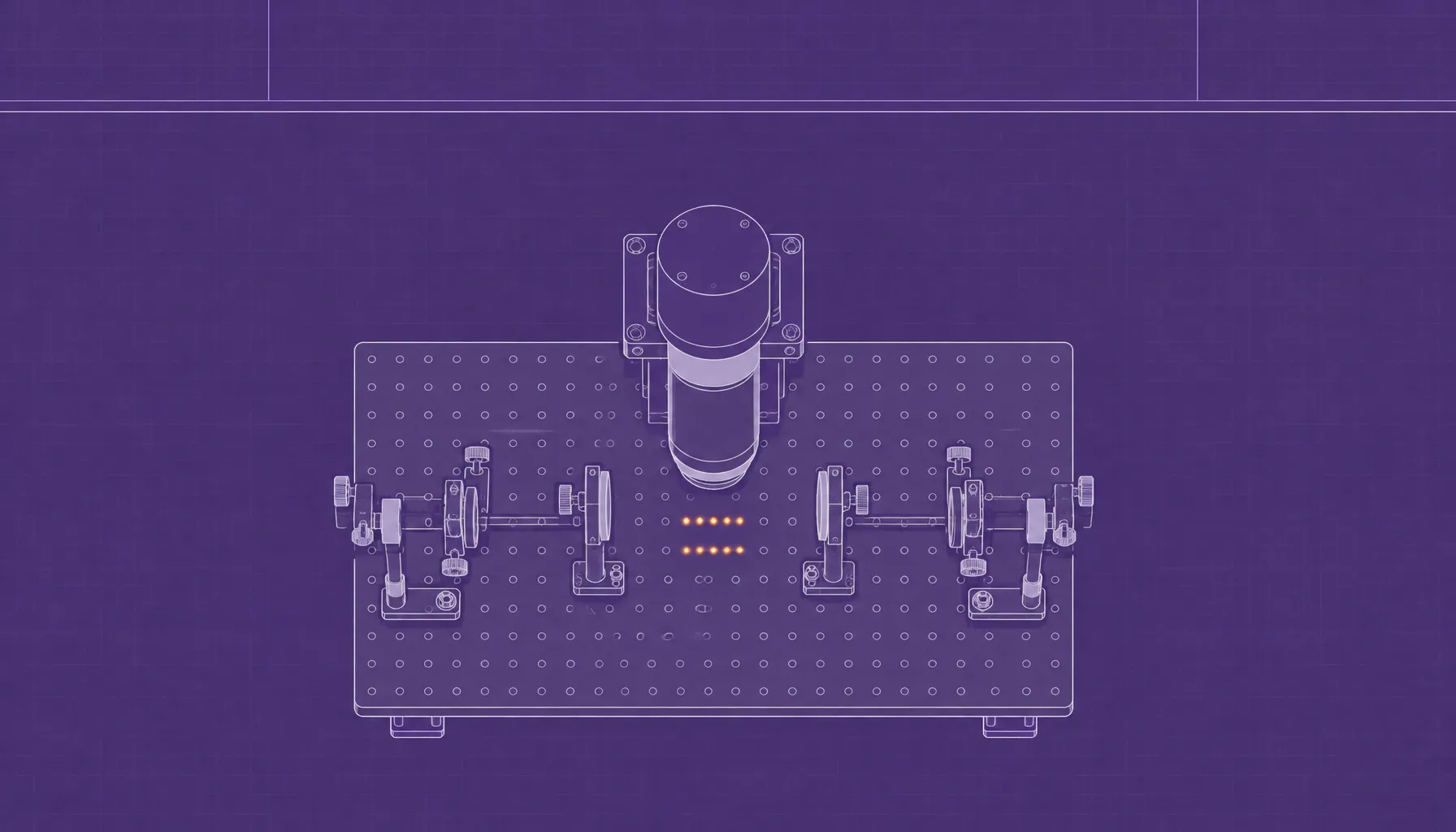
The researchers used rubidium atoms held in focused laser traps and excited into strongly interacting Rydberg states. By arranging the atoms in different geometries, they implemented a periodic Ising chain and a quasi-one-dimensional ladder made from two rows. The paper describes the chain as a 12-qubit system and the ladder as two 11-qubit chains, for 22 qubits in total.
To extract the excitations, the team quenched each system and tracked changes in local magnetization over time. A Fourier transform of that time series revealed dominant frequencies, which the researchers compared with predicted meson mass ratios. They refined the frequency estimates by fitting a multi-frequency model to the measurements.
The spectra point to E8 and D8(1)
For the chain, the researchers set the transverse field to the critical value, hx = 1, and the longitudinal field to hz = 4. A two-stage quench included a 400-nanosecond ramp before the measurement evolution. The authors report that four dominant measured frequencies agree with the predicted E8 spectrum.
For the ladder, they used hx = 1, hz = 0 and an interchain coupling λ = 1. The measured frequency pattern shows signatures consistent with the D8(1) predictions. Not every predicted mode must appear as a visible peak: the paper notes that symmetry-based selection rules leave only a subset with measurable weight in the zero-momentum spectrum.
The results also include evidence in the time domain. Correlations spread more slowly in the confined chain and weakly coupled ladder than in the unconfined system, and the ladder’s correlation front is not an absolute speed limit: weaker contributions from higher-energy modes can extend beyond the front associated with the lowest mesons. The experiment’s correlation measurements agree with classical numerical simulations up to the reported experimental noise.
Finite size and noise set the limits
The findings are signatures, not a measurement of every particle in either theory. In the chain, the authors say the initial state has limited overlap with higher E8 modes, restricting their visibility. The ladder spectrum has lower frequency resolution than the chain result because the matrix-product-state simulations use a finite time window, which broadens spectral features.
Those qualifications frame the paper’s contribution. Earlier work had reported evidence for E8 excitations in the material CoNb2O6; the direct observation of a bound-state spectrum arising from interchain coupling had remained elusive. Here, a reconfigurable atom array gives researchers a controlled way to compare the chain and ladder cases, while the reported D8(1) evidence remains a set of spectral signatures rather than a complete resolution of the predicted spectrum.