The Signal
One Transmon Connects Two Superconducting Waveguides
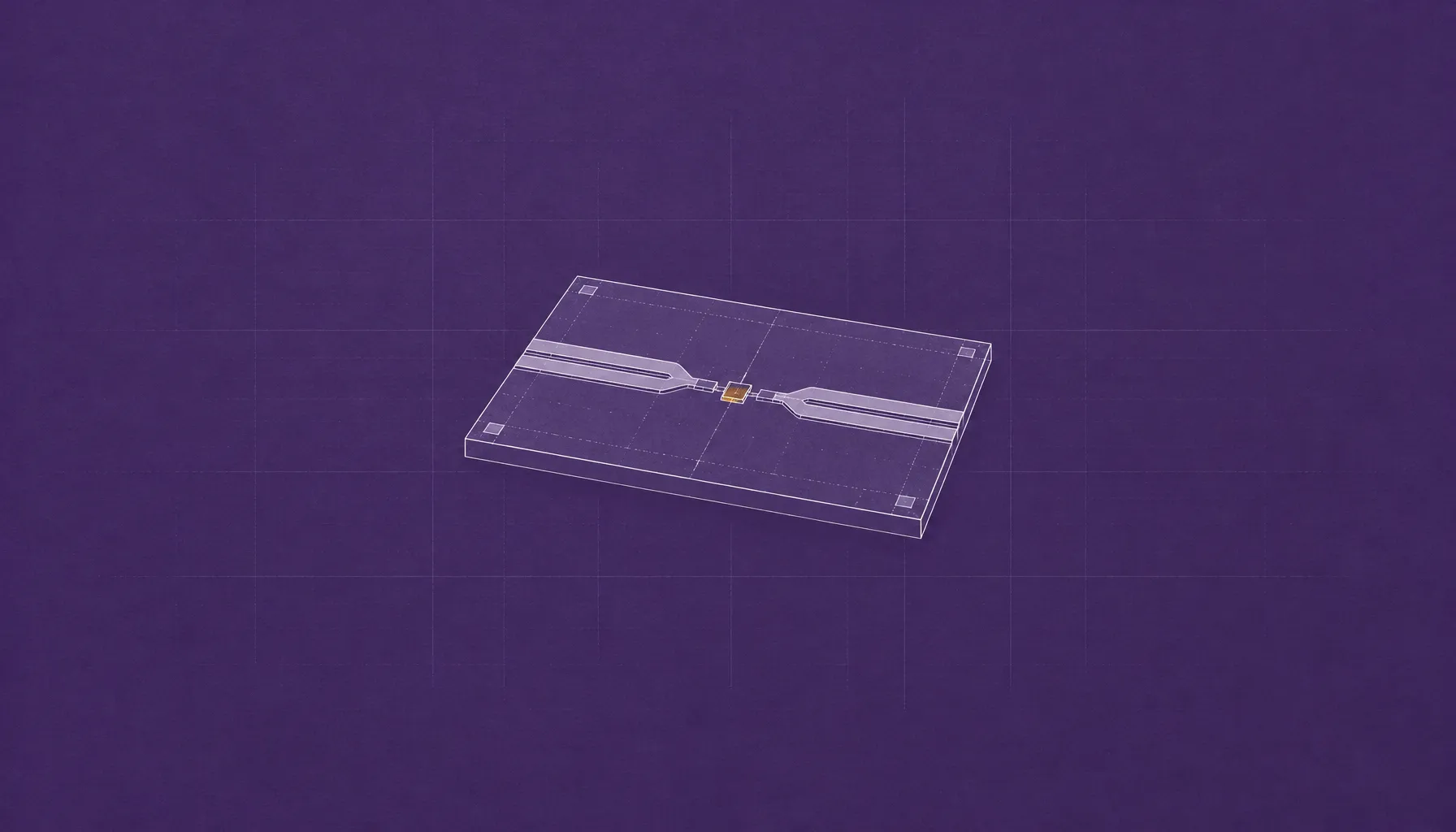
Researchers at the Leibniz Institute of Photonic Technology demonstrated a superconducting transmon that mediates microwave-photon transfer between two separate waveguides. Tested at 10 millikelvin, the device operated with an input signal
Quantum.world Team · Written with AI · fact-checked ·
One photon, two waveguides
At an average input of about one microwave photon, a single transmon can mediate transmission between two spatially separated superconducting waveguides. The experiment ran at 10 millikelvin, with the signal near 6 gigahertz, according to a paper published October 29 in npj Quantum Information. The team describes the device as a basic cell for a quantum microwave router: a four-port component in which a photon can pass through its original waveguide or cross into the other one.
“We report the first experimental realization and comprehensive characterization of a system consisting of two spatially separated superconducting waveguides coupled via a single transmon qubit,” write Evgeniya Mutsenik, Aidar Sultanov and their co-authors.
The work comes from researchers at the Leibniz Institute of Photonic Technology in Jena, Germany. Rather than joining two quantum processors, the device tests a smaller building block: one artificial atom that couples to both open microwave lines and can exchange photons with either. That arrangement gives researchers a way to study how a quantum emitter controls signals moving through separate channels.
Four paths through a transmon
The two waveguides create four transmission paths: two “through” channels, which carry a signal along the same guide, and two “cross” channels, which carry it from one guide to the other. At the transmon’s transition frequency, about 6.163 gigahertz in the reported device, the researchers observed a dip in through-transmission and a peak in cross-transmission. They attribute the cross signal to photons re-emitted into the waveguides after interacting with the transmon.
The team fabricated the aluminum transmon and coplanar waveguides on silicon. The waveguides sit at least 68 micrometers apart; their measured isolation was about −20 decibels. The researchers also fitted the four transmission responses to extract waveguide–qubit coupling rates of 2π × 1.82 megahertz and 2π × 2.31 megahertz.
Time-domain measurements gave the qubit an energy-relaxation time, T1, of 20.5 ± 2 nanoseconds. The authors estimate that coupling to the two waveguides accounts for most of that decay. In this device, the short lifetime is part of the same interaction that lets the transmon mediate photon transfer; the experiment is a study of the coupling, not a demonstration of a long-lived storage qubit.
Coherence sets the operating limits
The transfer depends on keeping the transmon coherent. When the researchers moved its magnetic-flux bias away from the point where the qubit is least sensitive to external fluctuations, their transfer metric fell to roughly 0.5. Their temperature measurements also point to dephasing as a main constraint on performance.
Photon number matters, too. The device behaved as expected at input levels below roughly 10 photons, but stronger signals saturated the transmon-mediated cross channels: through-transmission approached unity while cross-transmission dropped toward zero. The qubit could not process an increasing stream of photons as if each one encountered an unsaturated mediator.
What the measurements establish
The result establishes experimentally that one transmon can couple two separate superconducting waveguides and support cross-waveguide microwave transmission at low photon number. The authors compared steady-state measurements with time-domain tests and found them consistent with a model based on a non-Hermitian Hamiltonian. They also report a mismatch between the two measured cross-transmission magnitudes at resonance; their model does not explain it, and they point to possible reflections, impedance mismatches or internal losses.
That qualification matters for interpreting the device as a router. The study characterizes a basic cell and its response under controlled laboratory conditions; it does not demonstrate a multi-node network or routing between quantum processors. Its measured transfer is sensitive to flux bias, temperature and signal strength, while the cross-channel asymmetry remains unexplained.