The Signal
Monarch Supplies Photonics for NASA’s Quantum Gravity Pathfinder
Monarch Quantum says it is supplying integrated photonics hardware for Infleqtion’s work on NASA’s Quantum Gravity Gradiometer Pathfinder. The space-based sensor is designed to measure tiny variations in Earth’s gravity, with a flight demon
Quantum.world Team · Written with AI · fact-checked ·
A space sensor depends on more than its atoms
NASA’s planned quantum gravity sensor has a two-part engineering story: ultracold rubidium atoms form its measuring core, while tightly controlled light helps manipulate them. On October 20, Monarch Quantum said it is supplying integrated photonics hardware to support Infleqtion’s work on the mission, the Quantum Gravity Gradiometer Pathfinder (QGGPf). The announcement identifies a supplier role, but does not disclose the value or detailed terms of Monarch’s work.
The timing can make the funding sound like fresh news. NASA awarded Infleqtion a $20 million follow-on contract in August, bringing its investment in the program to $40 million, according to Infleqtion. Monarch’s October announcement describes its contribution to that next phase; it does not announce a separate NASA award to Monarch.
Monarch’s role is the light subsystem
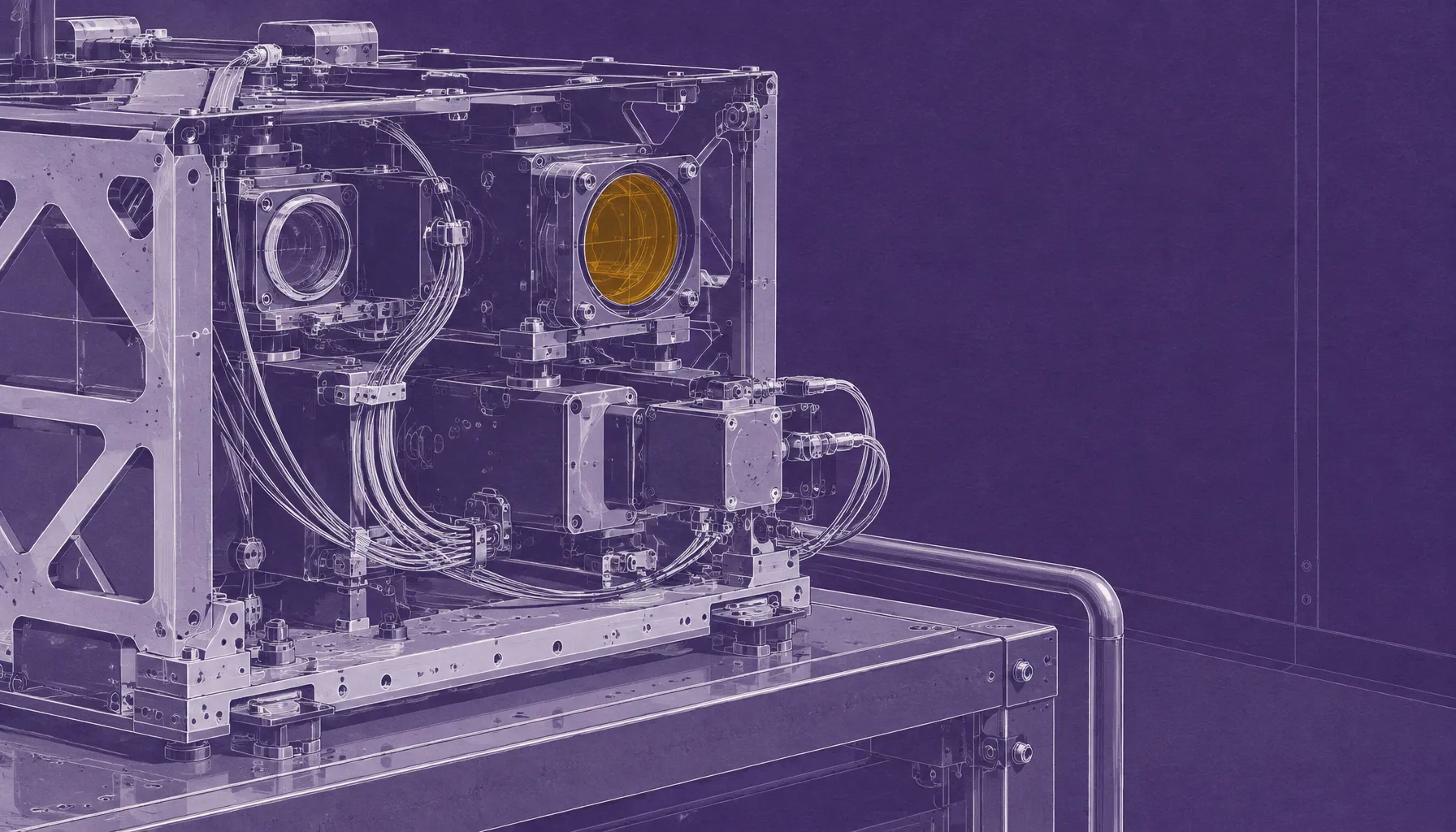
Monarch says its integrated photonics hardware supplies the precise, stable light needed for the sensor. The company describes its photonics engines as assemblies that bring together lasers, micro-optical components, fibers and control electronics. Its announcement does not specify which components it will deliver, quantities, contract value or qualification milestones.
Infleqtion’s stated role is broader: designing, maturing and integrating the atomic physics package, including vacuum, laser and control subsystems. The distinction matters. Monarch’s statement places it in the hardware chain supporting Infleqtion, but does not establish that it is the mission’s sole photonics supplier or that it replaces other NASA contractors.
“Quantum sensing is a systems challenge as much as it is a physics challenge.”
Tim Day, Chief Executive Officer and Chairman of Monarch Quantum
Two atom clouds compare their fall
QGGPf is designed to measure differences in Earth’s gravitational field using two clouds of ultracold rubidium atoms as test masses. NASA’s Jet Propulsion Laboratory explains that the instrument compares the clouds’ acceleration: small differences can reveal variations in gravitational strength. Such measurements could help inform future mapping of changes in groundwater, ice and other mass beneath or across Earth’s surface.
JPL’s 2025 description puts the planned instrument at about 0.25 cubic meters and 125 kilograms, sized for a single spacecraft. The mission is a technology demonstration, not an already operating Earth-monitoring service; NASA’s goal is to test whether the atom-interferometry approach works in orbit.
The 2030 flight remains a target
Infleqtion says the follow-on phase includes building an initial sensor head and electronics engineering development unit, then testing it at the Einstein Elevator, a drop-tower microgravity facility in Hannover, Germany. The company expects instrument hardware development to continue over the next three years and the mission to launch on a low-Earth-orbit spacecraft in 2030. Those dates are plans, not a completed flight schedule.
NASA’s JPL has previously described work with Infleqtion and AOSense on sensor-head technology, alongside a Goddard Space Flight Center effort with Vector Atomic on the laser optical system. Monarch’s new statement adds a named integrated-photonics supplier to the picture, without detailing how its hardware fits alongside those efforts. For now, the clearest new fact is the supplier relationship: Monarch says its photonics will support Infleqtion’s QGGPf work as the mission advances through hardware development and testing.