The Signal
Luthra and Owens Demonstrate QLDPC Surgery on Quantinuum H2-2
Surabhi Luthra and Alex Owens report a hardware demonstration of individually addressed logical Pauli measurements using QLDPC surgery on Quantinuum’s H2-2 trapped-ion processor. Their experiments use a seven-qubit gadget to measure one log
Quantum.world Team · Written with AI · fact-checked ·
Surabhi Luthra and Alex Owens report a hardware demonstration of individually addressed logical Pauli measurements using quantum low-density parity-check (QLDPC) surgery. Their paper, submitted to arXiv on October 28, describes experiments on Quantinuum’s H2-2 trapped-ion processor, where a seven-qubit ancillary gadget measures one logical qubit in a two-qubit code block.
The result addresses a practical requirement for QLDPC architectures: operations must target one encoded qubit without destroying the other. The researchers measured the logical X operator of a [[10,2,3]] generalised bicycle code, then used a second gadget to measure a commuting logical Z operator on the spectator qubit. They report that the gadget qubits can be reused between those measurements.
A seven-qubit gadget targets one logical qubit
QLDPC codes can encode multiple logical qubits in a shared block, but that compact encoding makes selective operations harder. In the surgery protocol, the code block is temporarily coupled to an ancillary gadget. Measurements of the gadget’s checks reveal the chosen logical Pauli value; fusion corrections then disentangle the gadget and return the data block to its code space.
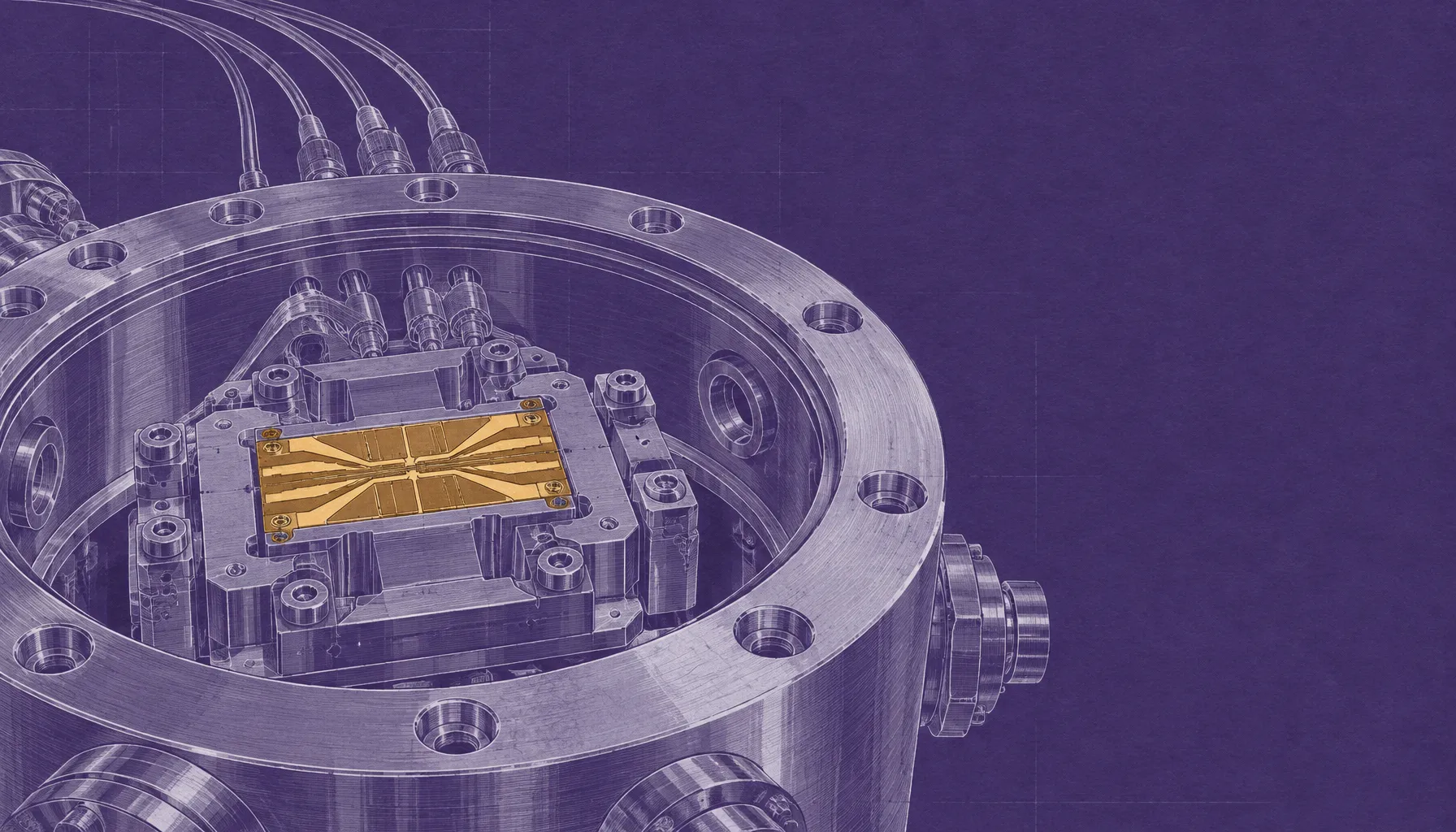
The H2-2 processor provides 56 qubits, all-to-all connectivity, and mid-circuit measurement and reset. The gadget experiments used 27 qubits: 10 data qubits, 10 stabilizer-check qubits and seven gadget qubits. The same gadget qubits served again for the sequential X-then-Z measurements.
“These results constitute a hardware validation of the generalised surgery primitive underlying Pauli-based computing for QLDPC architectures.”
Surabhi Luthra and Alex Owens, the paper’s authors, write.
Repeated checks lower the measured error bound
In a single round, the X measurement had a reported error rate of 0.72%, with a 95% credible interval of 0.32% to 1.41%, relative to the verified logical preparation. Compared with a later destructive transversal measurement, the error rate was 1.03%, with a 95% interval of 0.60% to 1.65%. The single-round gadget measurement itself is vulnerable to a single faulty check readout.
For the repeated-measurement test, the team extracted the gadget syndrome over three rounds and decoded the full syndrome history rather than taking a simple majority vote. They recorded no logical errors in 957 verification-passing shots, placing the error rate below 0.26% at 95% credibility. That bound depends on verification: without it, the same three-round run had 10 errors in 1,000 shots.
The spectator qubit survives the measurement
The authors checked whether surgery preserved the unaddressed qubit by reading it after measuring its partner. In the three-round X-measurement experiment, the spectator’s error rate was 0.21%, with a 95% credible interval of 0.04% to 0.67%. In the sequential test, the second gadget measured the spectator’s logical Z with a 1.12% error rate, with a 95% interval of 0.60% to 1.94%.
The paper describes the work as a minimal-distance demonstration, and its decoding runs offline. The authors identify real-time decoding with feed-forward, measurements of logical Pauli products, and tests on higher-distance codes as steps still needed toward larger-scale Pauli-based computing. For now, the reported hardware result is a [[10,2,3]] code, a seven-qubit gadget and a verified three-round measurement bound below 0.26%.