The Signal
Harvard Team Uses Tension to Boost SiV–Phonon Coupling
Harvard researchers report that tensioned diamond nanobeams can improve mechanical coherence while increasing coupling to silicon-vacancy centers near the beams’ clamps. Their experiments show a tenfold clamp-to-center coupling increase, bu
Quantum.world Team · Written with AI · fact-checked ·
Tension can make a mechanical resonator quieter, but it also raises a concern for quantum devices: the strain that couples a resonator to a defect might weaken as mechanical losses fall. A team at Harvard reports a way around that trade-off in diamond nanobeams, where strain from vibration concentrates near the clamps and strengthens coupling to silicon-vacancy centers placed there.
The experiments show tenfold stronger coupling at a clamp than at the beam’s center, alongside mechanical quality factors as high as 26 million. The result concerns coupling between the beam’s motion and SiV orbital states; a coherent interface to the defect’s spin states remains a proposed next step, not a demonstrated result.
Strain gathers at the nanobeam’s clamps
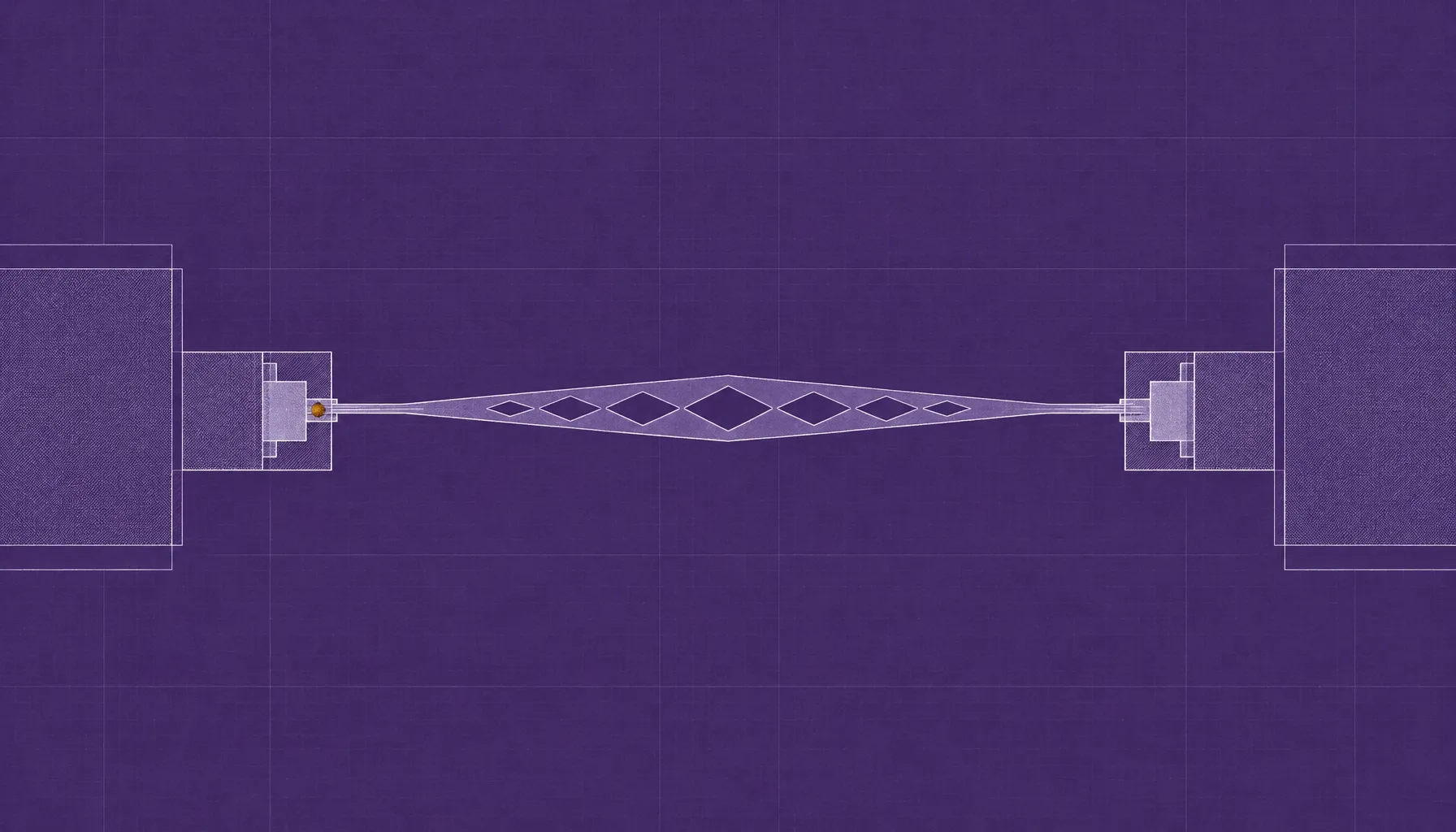
Guanhao Huang, Amberly Xie, Chang Jin, Evelyn Hu and Marko Lončar built the devices from suspended diamond beams that acquire tension through a van der Waals self-assembly process involving water condensation. The beams are 200 micrometers long and about 217 nanometers thick. The team implanted SiV centers at five positions along each resonator to compare their response to static strain and vibration.
In a tensioned beam, static stress confines bending to a narrow region near the supports. That concentrates the changing, or dynamical, strain at the clamps even as tension reduces mechanical dissipation. The researchers used optical measurements of the SiV emission to track how that strain shifted the defects’ spectral lines, including at the clamp, where the beam’s displacement is too small for direct interferometric measurement.
A stronger coupling measurement—and a correction
At the clamp, the measured SiV orbital coupling to mechanical motion was ten times higher than at the beam’s center. The team reports that tension-driven dissipation dilution improved the device’s mechanical quality factor by as much as a factor of 30 over its intrinsic value. The most highly strained devices reached a mechanical quality factor of 26 million; the intrinsic material quality factor was about one million at 4 kelvin, with no measurable degradation from the ion implantation used to create SiVs.
The work also revises an important input for future device designs. By calibrating strain through the resonator’s measured frequency, the researchers found the SiV orbital response to strain to be about 0.356 times the previously reported value—roughly three times lower. That correction means earlier estimates of spin-phonon coupling were too high, the authors say, and makes local strain enhancement more consequential for recovering strong coupling.
“This allows us to enhance SiV-mechanical coupling and the mechanical coherence simultaneously, and provide a SiV-strain sensitivity with greatly improved accuracy over previous literature values.”
Guanhao Huang, Amberly Xie, Chang Jin, Evelyn Hu and Marko Lončar, “Dissipation dilution enhances SiV coupling to vdW diamond nanomechanics”
The spin interface is still a proposal
The measured orbital cooperativity—the ratio describing coherent coupling relative to losses—reaches about 100, roughly a thousandfold improvement over the comparison described in the paper. But at 4 kelvin, the authors calculate the orbital quantum cooperativity at only about 10−3, because thermal occupation of the MHz mechanical mode overwhelms that interaction. The experiment therefore does not establish a quantum-coherent spin-phonon interface.
Instead, the paper models a different clamp geometry that separates static strain from the dynamical strain concentrated near the support. In that design, the authors estimate spin-phonon coupling of about 1.5 kilohertz and quantum cooperativity of roughly 3 × 10⁵ under specified conditions, including operation at 100 millikelvin. Those are projections, not measurements from the reported device.
The researchers also flag a material question for colder operation: whether diamond with implanted SiVs can retain the very high mechanical quality factors previously demonstrated in pristine material at millikelvin temperatures. For now, the measured advance is narrower and concrete: a tensioned diamond beam maintains high mechanical quality while delivering its strongest measured SiV coupling at the clamp.