The Signal
Harvard Physicists Set Out Exponential Speedups for Signal Sensing
A quantum sensing protocol described in Physical Review X can estimate multiple properties of a classical signal from one dataset, with below-vacuum-level noise. For specially structured waveform priors, the authors prove an exponential red
Quantum.world Team · Written with AI · fact-checked ·
For certain signal-learning problems, an entangled sensing protocol can reduce the required measurements from at least Ω(3n) to O(ε−2 log M), independent of the signal dimension n. The comparison, published October 23 in Physical Review X, applies to specially structured waveform priors and Fourier-domain matched filtering—not to every classical signal or a demonstrated sensor.
Jordan Cotler, Daine L. Danielson and Ishaan Kannan of Harvard University and the Massachusetts Institute of Technology call their framework quantum signal learning, or QSL. It treats sensing as learning properties of a signal’s response distribution, rather than estimating only one preselected parameter. Their Bell QSL protocol aims to gather a reusable record for estimating multiple properties after measurement.
One record, both quadratures
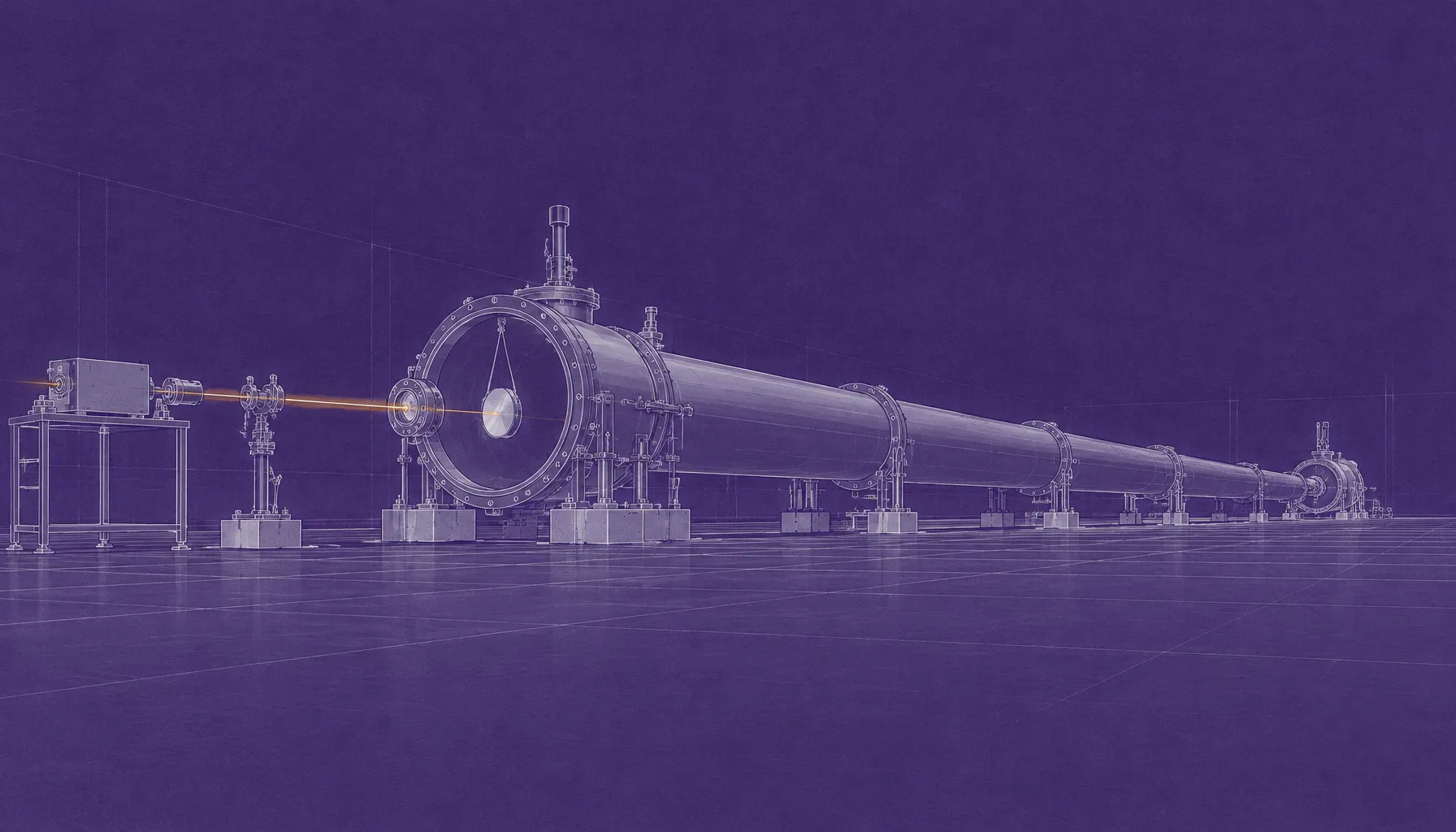
The protocol prepares two-mode squeezed states, sends one mode through the sensing interaction and keeps its partner as an idler in quantum memory. After the signal interaction, the modes meet at a 50:50 beam splitter and undergo homodyne measurements in a fixed basis. The resulting outcomes encode both quadratures, with noise below the vacuum level set by the squeezing.
That combination addresses a trade-off in conventional readout. Heterodyne detection records both quadratures and supports later analysis, but carries vacuum noise; homodyne detection can reduce noise below that level along a selected quadrature, yet reveals only a projection of the signal. Bell QSL is designed to provide a more complete dataset without repeatedly changing measurement settings or relocking squeezing axes.
The paper’s authors, Jordan Cotler, Daine L. Danielson and Ishaan Kannan, write:
“Our work makes such quantum learning advantage statements precise, demonstrating utility for ubiquitous physical tasks such as electromagnetic field sensing and interferometric feedback control.”
Where the speedup applies
The paper analyzes sensing electromagnetic-field correlations, tracking phase or control errors in interferometric cavities, and scoring candidate waveforms through matched filtering. In its matched-filter result, the authors construct priors for which any strategy without entanglement needs at least Ω(3n) channel uses to score one template to constant accuracy. Bell QSL, with squeezing that scales as Θ(log n), estimates M template scores to accuracy ε in O(ε−2 log M) shots, with no n term in that bound.
The authors stress that the exponential separation occupies a narrow part of the problem space: it depends on a highly structured prior that hides information from unentangled measurements. Their separate analysis of electromagnetic correlations finds a practical advantage over fixed-axis homodyne and heterodyne baselines when relevant correlations are difficult to distinguish from near-symmetric quadrature noise. The size of that benefit depends on how much signal information the competing measurements obscure.
Memory loss sets a precision floor
The study presents theoretical protocols and complexity analyses, not a new experimental demonstration of gravitational-wave, radar or dark-matter sensing. Its proposed ingredients—two-mode squeezing, passive optics and static homodyne measurements—are familiar in quantum optics, but the idler must remain coherent while the sensing mode interacts with the signal. The authors identify that requirement as a challenge for lower-frequency applications with longer integration times.
Photon loss during storage can impose a precision floor: below it, the paper says, the provable speedup disappears when compared with a noiseless benchmark. The work therefore leaves a practical question alongside its mathematical results: can a real sensor preserve the stored entanglement long enough, and with low enough loss, to retain the advantage for the signals it needs to measure?