The Signal
Researchers train chemistry circuit generator on 70-qubit hardware
Researchers trained a chemistry circuit generator using feedback from an IBM quantum processor at up to 70 qubits. In tests on organotin models, the team reports that most larger-system runs came within 15 mHa of a classical reference.
Hardware feedback for circuit design
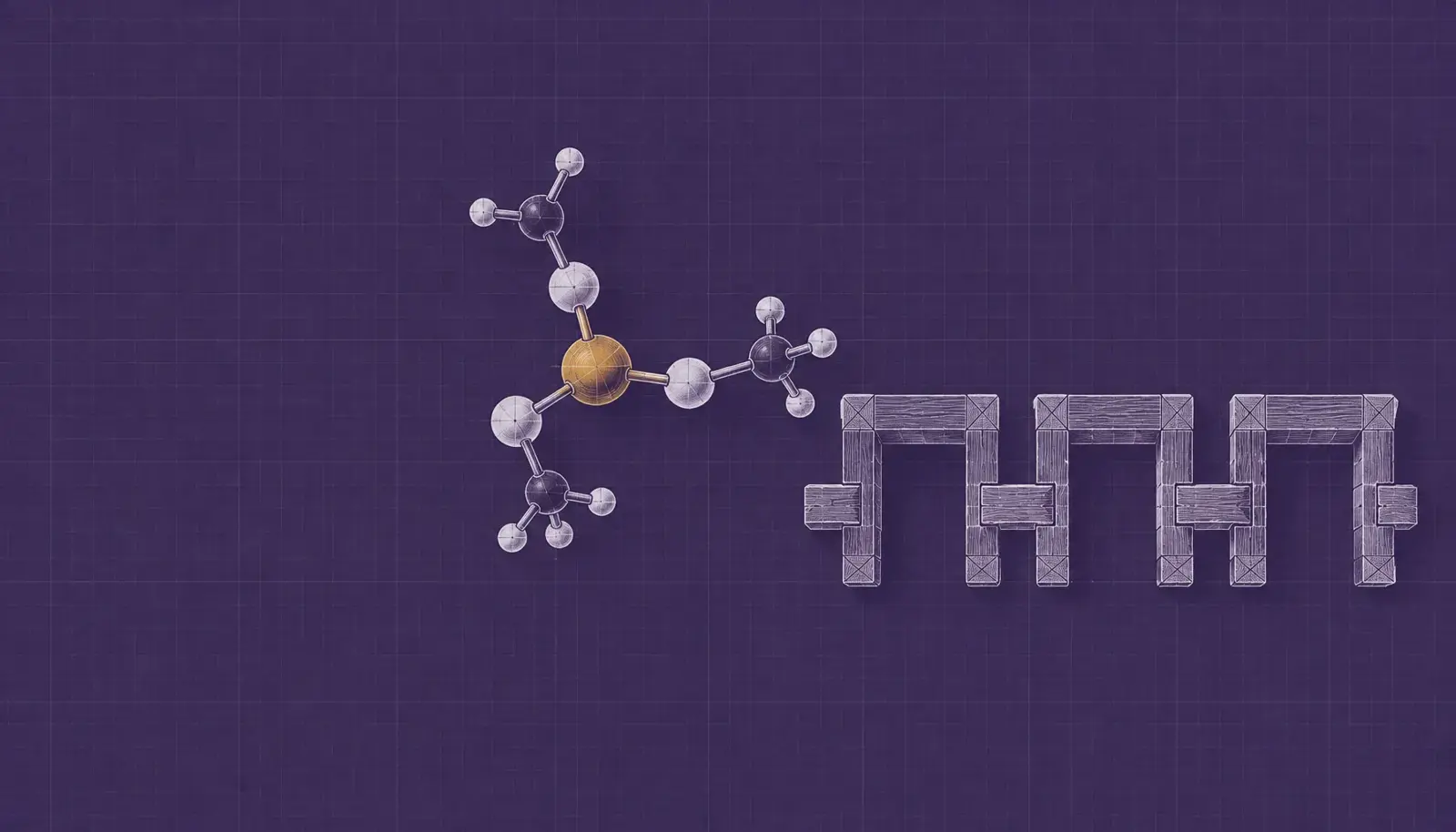
Researchers used an IBM Heron processor to train a chemistry circuit generator with feedback from quantum hardware at up to 70 qubits. In an arXiv preprint, the team reports that the resulting policies could generate circuits for organotin models without being retrained on those molecules.
In tests of circuits for larger active spaces, 27 of 28 runs at 46–70 qubits produced energies within 15 millihartree (mHa) of a density-matrix renormalization group reference, with a median error of 4.5 mHa. The results followed hardware sampling and classical ranking and recovery, rather than a quantum-processor calculation alone.
The models cover methyltin trihydroxide and its hydrates, which the paper describes as minimal models of organotin photoresists for extreme-ultraviolet lithography. The policies had instead been trained on transition-metal complexes.
From simulation to a processor
The method uses a generative quantum eigensolver: a transformer model takes molecular descriptors as input and produces a sequence of operations from a pool of candidates. Those operations form a circuit for preparing a state that can be sampled for a chemistry calculation.
Training began on a noiseless simulator before continuing on the ibm_kobe processor. In the hardware stage, sampled circuits were scored using results that included the effects of device noise and the constraints of adapting circuits to the machine.
For the main training configuration, the researchers report 600 hardware-stage iterations across four policy lineages, comprising 12,000 circuits and 120,000,000 shots. IBM billed 648 quantum-processing-unit minutes for those jobs, according to the paper.
The training reward included a penalty against generating circuits that sampled only the Hartree–Fock reference determinant. A classical reference energy for the training molecules was also used in an admission gate and auxiliary reward terms.
Testing on unseen molecules
For each target, the policy generated ten circuits, each sampled once on the processor. The team cached the measurement counts, ranked the circuits and used classical recovery and the molecular Hamiltonian to obtain energies without further quantum-processor calls.
Across all 43 reported trained runs, spanning active spaces from 32 to 70 qubits, the median error against the classical reference was 2.8 mHa, the researchers report. The trained policy was more accurate in all eight runs for which an untrained control was used.
The paper describes its evidence for transfer to new chemistry as qualitative. It also says some samples from the main trained policy were nearly identical, rather than representing a rich variety of independent circuits; ranking and recovery after sampling contributed substantially to the accuracy.
Gate counts and costs
For selected circuits at 56–70 qubits, the team reports 34–72 times fewer two-qubit gates than a local unitary cluster Jastrow circuit adapted for the same device. The selected generated circuits used 64–160 two-qubit gates, compared with 4,248–6,952 for that baseline.
Sampling ten generated circuits took about 11 times the quantum-processing-unit time per job of sampling one baseline circuit, the paper reports. It also found that classical recovery dominated wall time in both training configurations tested.
The researchers compared the main penalty with a more extensively tuned reward. They say the tuned version did not demonstrably improve hardware results at the resolution of the study and had a less reliable tail of best-circuit errors, so they made the simpler penalty the main configuration.
Sources
Related stories
- IBM, RIKEN and NVIDIA report 79-fold gain in iron-sulfur simulation
- SQD Recovers FeO Model Ground States from IBM Quantum Samples
- PNNL Breaks a 164-Qubit Chemistry Model into 12-Qubit Tasks
- Qunova says HI-VQE reaches chemical accuracy in an 80-qubit calculation
- ERPA Cuts VQE Energy Errors by Orders of Magnitude