The Signal
Gonçalves, Yang and Lin Find a Route to Chiral Pairing
Miguel Gonçalves, Kun Yang and Shi-Zeng Lin propose a route to chiral superconductivity by hole-doping a Chern ferromagnet. Their calculations find a narrow, model-specific spin-orbit-coupling range in which skyrmion-like Cooper pairs could
Quantum.world Team · Written with AI · fact-checked ·
At an Ising spin–orbit coupling of 0.222 to 0.23, a theoretical model leaves room for chiral superconductivity: a narrow interval in which bound pairs repel one another and could condense. The interval is specific to the repulsive Kane–Mele–Hubbard model and to an interaction strength of 100 in the authors’ model units. Miguel Gonçalves, Kun Yang and Shi-Zeng Lin report the result in a Physical Review Letters paper accepted on October 22.
A Cooper pair with a magnon inside
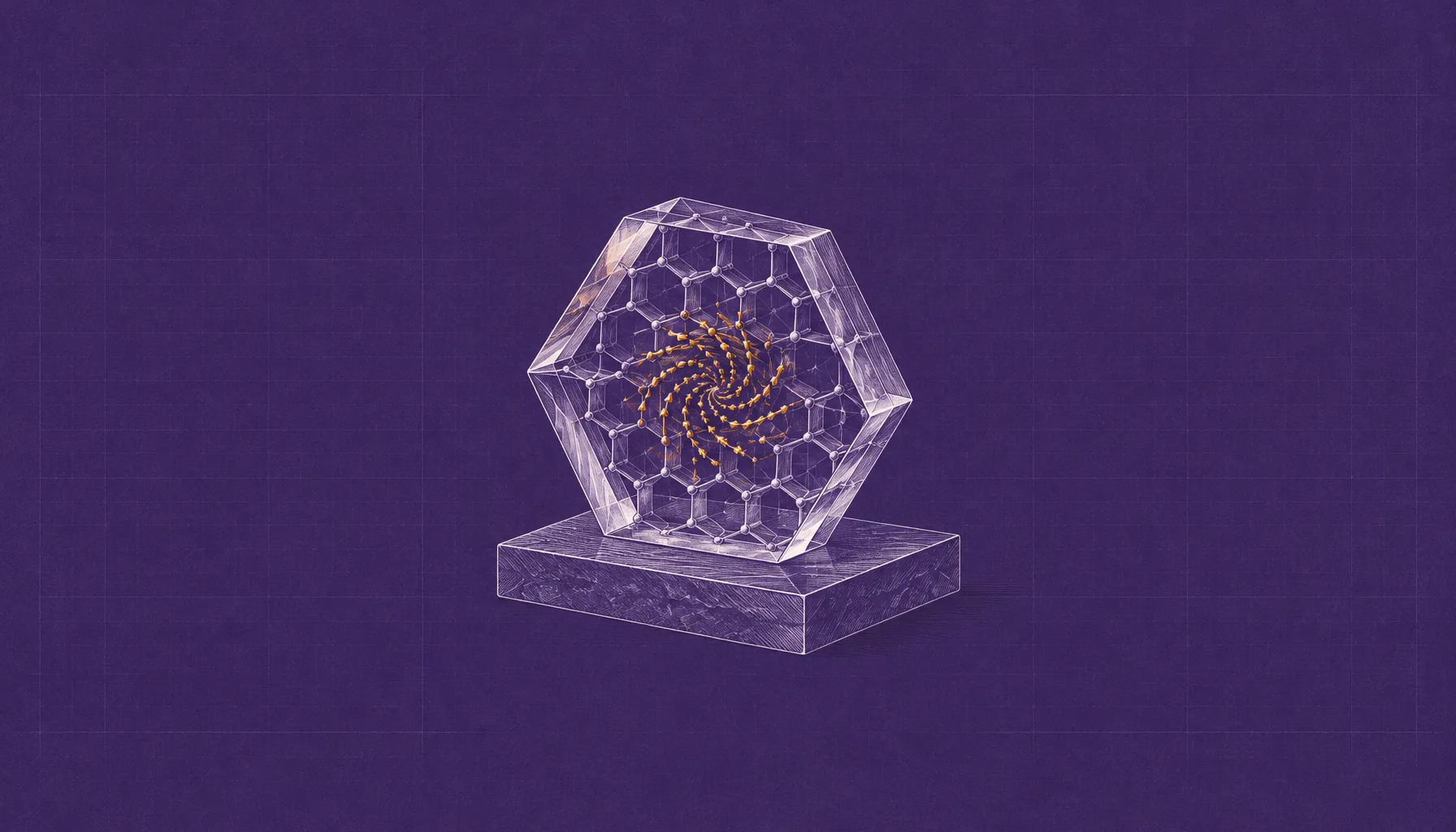
The proposed pair is not simply two holes. The calculations find that two holes bind with a magnon, a spin-flip excitation, to form a charge-2e composite. The authors call it a skyrmion-bipolaron: its spin texture is noncoplanar, and its spin chirality—the handedness of the spin arrangement—is finite.
“We show that chiral superconductivity can be stabilized by hole doping a Chern ferromagnet,” write Miguel Gonçalves, Kun Yang, and Shi-Zeng Lin. Their calculations find that the composite has chiral f-wave pairing symmetry. Reversing the polarization of the parent Chern ferromagnet reverses the spin chirality and the direction of the pairing’s phase winding.
Why the spin-orbit window matters
The team uses exact diagonalization and density-matrix renormalization group calculations to study hole doping in the honeycomb-lattice model. The Chern ferromagnet provides the magnetic starting state; adding holes allows spin-flip excitations to bind with them. The resulting pair’s chirality and pairing symmetry are tied to the Chern number, or polarization, of that parent state.
Pair formation alone does not establish superconductivity. The researchers also calculate how skyrmion-bipolarons interact: below a second spin-orbit threshold, they repel, while above it they attract. At interaction strength 100, the paper gives thresholds of 0.222 and 0.23, respectively. In the narrow interval between them, the pairs are stable while still repelling, a combination the authors say could allow a dilute gas of the charge-2e composites to condense.
A model result, not a materials demonstration
The result is a theoretical mechanism, not an experimental observation of this pairing state. The paper says the mechanism can arise spontaneously at zero magnetic field, unlike earlier magnon-mediated proposals that require a sufficiently large Zeeman field. That distinction matters because the proposed bound state carries a noncoplanar spin texture as well as chiral pairing.
The authors suggest the mechanism may be relevant to superconductivity observed in a MoTe2 moiré superlattice, where spin-flip and spin-polarized excitations may be energetically competitive. They do not show that the material realizes the skyrmion-bipolaron state. Their paper also says it does not attempt an exhaustive scan of model parameters, and describes the intermediate spin-orbit interval as small and dependent on model details.
The test left for MoTe2
The proposed route connects three ingredients—Chern ferromagnetism, magnon-bound holes and repulsive interactions between pairs—in a specific theoretical setting. Establishing its relevance to a material will require showing that the required bound pairs and parameter window occur there. The paper does not establish that MoTe2 occupies the 0.222-to-0.23 interval.