The Signal
GaAs Triple Dot Delivers 4.05-Nanosecond Spin Gates
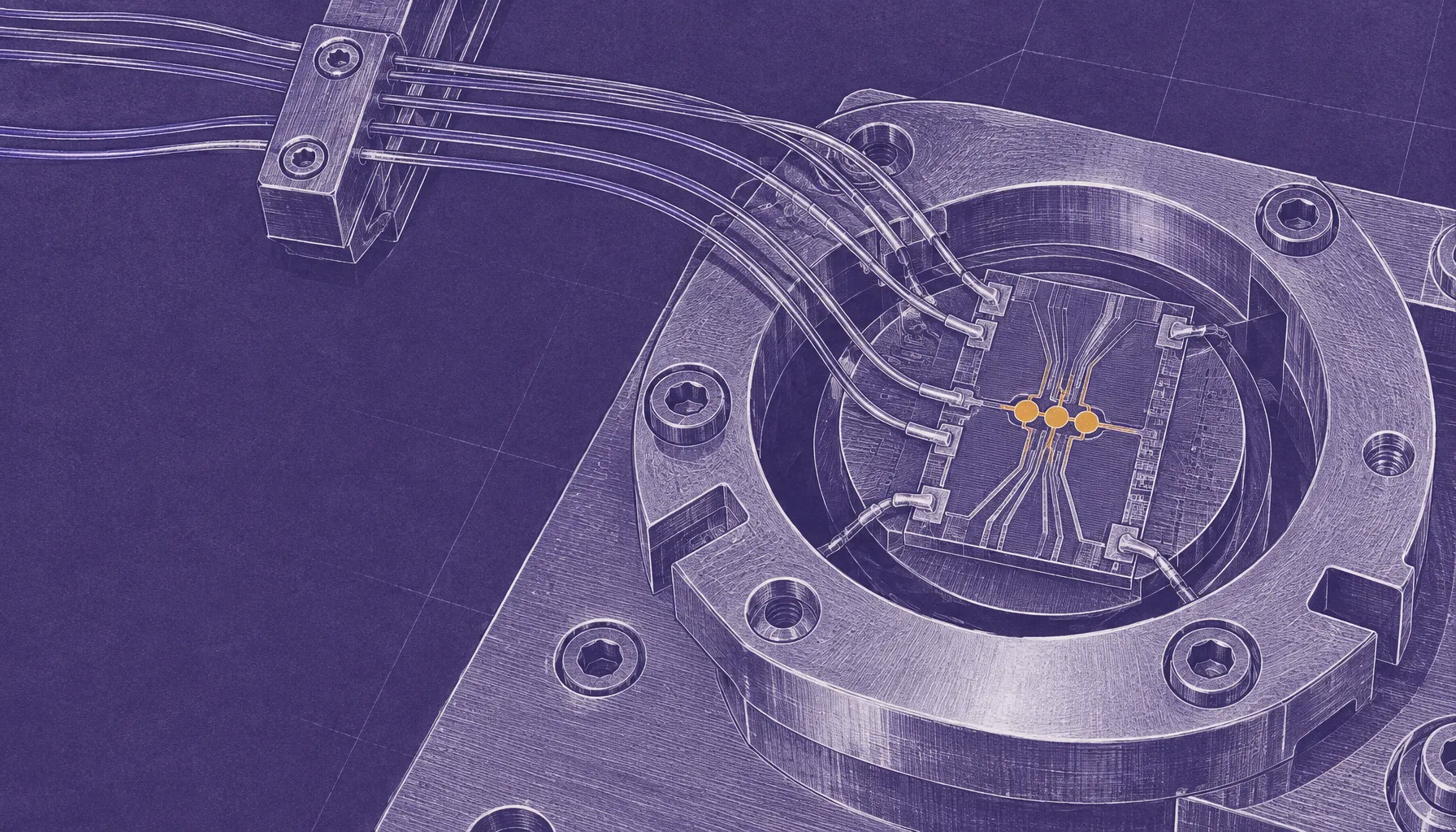
A GaAs triple-quantum-dot experiment reports a 99.56% fidelity single-spin π/2 gate completed in 4.05 nanoseconds. The design uses a third-dot tuning control and neural-network feedback to address slow qubit-frequency drift.
Quantum.world Team · Written with AI · fact-checked ·
A 4.05-nanosecond rotation
A 4.05-nanosecond π/2 gate with 99.56% fidelity is the headline result from a GaAs triple-quantum-dot experiment published on 24 October in npj Quantum Information. The researchers combine an electrical design change with feedback that tracks slow shifts in the qubit’s frequency. Their approach targets a familiar tension in quantum-dot control: stronger coupling between a spin and its charge motion can speed rotations, but can also make the qubit more vulnerable to electrical noise.
The result concerns a single-spin, or flopping-mode, qubit—not a two-qubit gate or an operating quantum processor. It shows how a third dot can provide a tuning control that a double-dot design lacks, while feedback addresses slow frequency drift. Those distinctions matter: the reported fidelity describes a specific gate at a particular operating point, not the performance of a larger system.
Why add a third dot?
In a double-quantum-dot flopping-mode qubit, the width of the low-sensitivity “sweet spot” and the enhancement of the Rabi frequency depend on the same orbital splitting. That links gate speed and noise tolerance, restricting how independently researchers can tune them after fabrication. The new design uses a GaAs triple quantum dot and adjusts the detuning of its third dot, written as ε34, to add another electrical control parameter.
By tuning ε34, the team flattens how the qubit frequency changes with detuning in the target double-dot pair, while retaining strong spin-charge hybridization. The device then supports electrically driven Rabi frequencies above 100 MHz. In practical terms, the extra dot is not simply another qubit: it helps shape the orbital energy levels used to control the spin.
Feedback tracks slow frequency drift
Orbital tuning addresses the device’s response to detuning, but it does not eliminate frequency drift over time. The researchers use feedback based on a feedforward neural network to track slow changes in qubit frequency. In their measurements, the feedback reduces the standard deviation of those slow fluctuations to 388 kHz.
“Here, we demonstrate a GaAs triple-quantum-dot (TQD) flopping-mode qubit in which the detuning of the third dot, ϵ34, provides an additional electrical tuning parameter for orbital-band flattening.”
Yuta Matsumoto et al., authors of the study
The 99.56% figure is the fidelity reported with feedback at the stated gate duration. It should be read alongside the method that produces it: the device design supplies an adjustable operating point, and the neural-network feedback compensates for slow frequency fluctuations. The paper’s abstract identifies this as a route to tuning the speed-coherence trade-off, complementary to relying on a material’s intrinsic spin-orbit coupling or a fixed micromagnet geometry.
A device-level result, not an array demonstration
The experiment is a demonstration of control in a GaAs device, not evidence that the same performance carries over unchanged to other materials or larger arrays. Its contribution is narrower and concrete: a third-dot detuning adds an electrical knob for flattening the qubit-frequency response, and feedback helps preserve the operating point against slow drift. The reported benchmark is a 99.56% single-qubit π/2 gate completed in 4.05 ns.