The Signal
Fuzhou Team Tracks Decoherence Across Eight Environmental Qubits
A Fuzhou University team tested how a microwave cat state loses and regains interference as its controllable environment grows to eight qubits. The experiment mapped a crossover to apparently irreversible decoherence, with revival suppresse
Quantum.world Team · Written with AI · fact-checked ·
With eight environmental qubits coupled to a microwave cat state, interference faded without returning during the experiment’s first 30 nanoseconds. A Fuzhou University team used a controllable circuit to track how adding environmental degrees of freedom changes decoherence from reversible to apparently irreversible. The work appeared in Physical Review Letters on October 5, 2026; Phys.org reported the findings on October 23.
Eight qubits hold the record
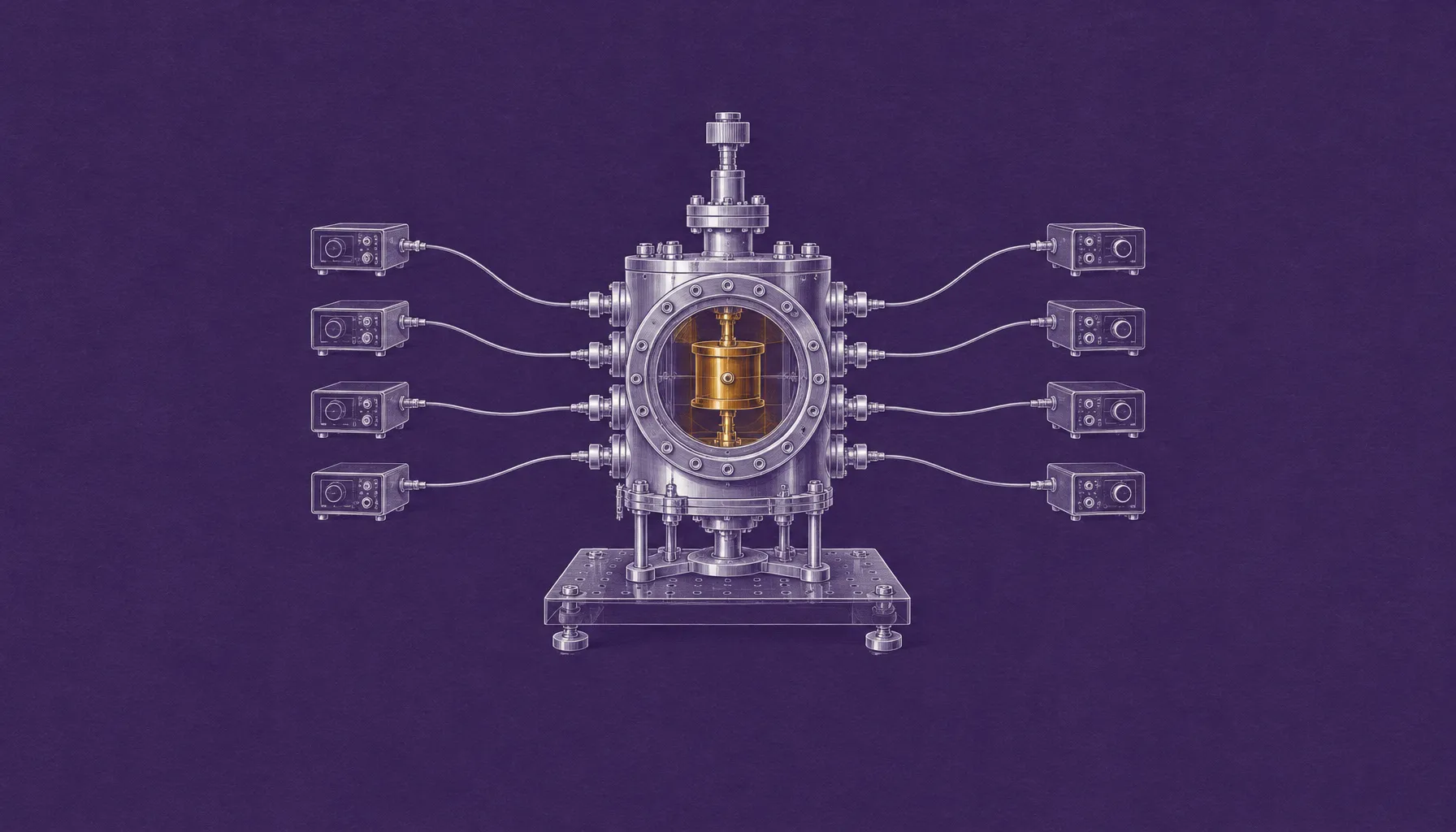
The experiment places a photonic cat state in a bus microwave resonator, then couples that resonator to selectable nonlinear electronic oscillators. Each oscillator acts as one degree of freedom in the engineered environment. The Fuzhou University group’s device includes eight environmental qubits, alongside two auxiliary qubits used to prepare the field state and probe its coherence.
A cat state combines distinguishable possibilities—in this case, a microwave field with no photons and one containing light. Interference between those components produces a signature that can be reconstructed in a Wigner map. As the environment acquires information that distinguishes the two possibilities, the interference fringes fade; if that information later disappears, the fringes can return.
One oscillator lets coherence return
With one environmental qubit, the team observed interference nearly revive about 38 nanoseconds after the interaction began, according to Phys.org’s account of the experiment. In that configuration, the environment’s record could be erased through continued system–environment interaction, without a separate erasure operation. The test offers a controlled view of how information stored outside a quantum system can suppress its observable coherence, even when nobody reads that information directly.
As the researchers added environmental qubits, oscillations in the measured distinguishability weakened. That measure tracks how well the environment can tell the cat state’s two components apart: zero means it carries no distinguishing information, while one corresponds to an unambiguous distinction. With eight qubits, the measure approached one after roughly 15 nanoseconds and stayed close to that value through measurements extending to 80 nanoseconds, Phys.org reported.
“Sufficiently many oscillators” change the outcome
The paper’s authors summarize the change this way: “When the reservoir contains sufficiently many oscillators, the which-path information acquired by the reservoir cannot be erased by the system-reservoir interaction at later times.” Ri-Hua Zheng et al., Fuzhou University
The result is a controlled demonstration of a progressive crossover, not evidence that interference can never return. The observed eight-qubit data show that revival is suppressed over the measured interval; they do not establish what would happen at all later times. That distinction matters because irreversibility in a finite, engineered system can describe what is observable on a given timescale without proving that recovery is impossible in principle.
A testbed for open quantum systems
The team also characterizes the system’s non-Markovian behavior, a way of describing dynamics in which a system’s history and its environment’s response matter. The setup lets researchers vary the number of environmental degrees of freedom while studying the same kind of mesoscopic superposition. Cat states are of interest in quantum measurement and quantum technologies, but this experiment does not demonstrate a technique for protecting them from decoherence.
The measurements instead make the environment’s growing information record experimentally accessible: one qubit permits a near revival, while eight suppress it across the reported window. How long that suppression persists beyond 80 nanoseconds, and how the crossover changes with other reservoir settings, remain open experimental questions.