The Signal
Fraunhofer Team Switches Off NV Laser for 100% Magnetic Contrast
A Nature Communications study reports an NV-diamond magnetometer inside a laser cavity that reaches 100% optical contrast. The team calculates photon-shot-noise sensitivity limits below 400 fT/√Hz for all vector components, but has not achi
Quantum.world Team · Written with AI · fact-checked ·
“Here, we demonstrate a laser threshold magnetometry-based NV system that achieves 100% optical contrast in combination with strong output signals up to 50 mW.”
Florian Schall et al., Nature Communications
A team led by researchers at Fraunhofer’s Institute for Applied Solid State Physics reports that result in a paper published October 22 in Nature Communications. The experiment places nitrogen-vacancy (NV) centers in diamond inside a laser cavity and reads magnetic-field changes through the laser’s output, rather than through the diamond’s fluorescence. When a microwave field drives the NV centers into magnetic resonance, the cavity laser can switch off.
A diamond becomes part of the laser
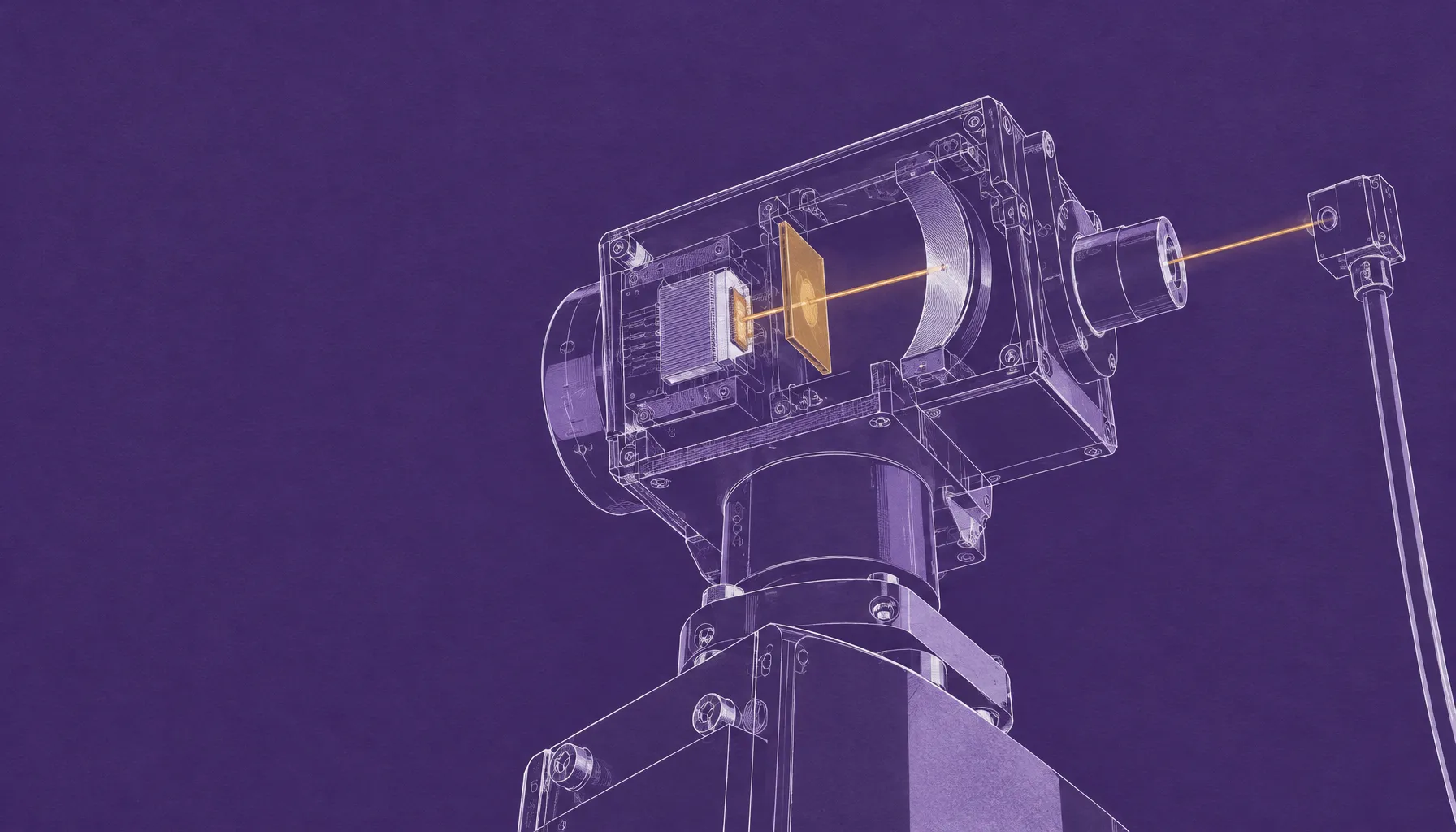
NV centers are defects in diamond whose electron-spin states respond to magnetic fields. Conventional NV magnetometers typically infer those changes from fluorescence; the study says ensemble sensors usually produce only a few percent optical contrast. In the new setup, the diamond instead acts as a magnetic-field-dependent absorber within the cavity, turning spin-dependent absorption into a change in laser output.
The researchers pair the diamond with a membrane external-cavity surface-emitting laser, or MECSEL, that supplies gain at 1042 nanometers. A green 532-nanometer pump laser prepares the NV centers, while microwaves are swept across their spin resonances. Near the laser’s threshold, a change in absorption can push the cavity below the point where it lases, producing the reported full contrast.
Two operating points, two sensitivity limits
The team reports a photon-shot-noise sensitivity limit of 1,160 femtotesla per square-root hertz alongside an intrinsic dynamic range of ±280 microtesla in one measurement configuration. With a different diamond sample and adjusted settings, the researchers demonstrate vector magnetometry: the sensor resolves the three components of a magnetic field. In that configuration, the calculated photon-shot-noise limit is below 400 fT/√Hz for all vector components, with a dynamic range of ±40 microtesla; the most sensitive orientation reaches 127 fT/√Hz.
Those figures describe a trade-off within the experiment, not one single operating point: the improved sensitivity in the vector configuration comes with a smaller dynamic range. The paper also compares the combined sensitivity-and-range performance with a fitted trend for other magnetometers, reporting an improvement of up to 590 times against that trend. That factor is a comparison based on the authors’ plotted sensor data and calculated limits, not a direct head-to-head test against each competing instrument.
The 400-fT figure is a limit, not a measured sensitivity
The distinction matters because the reported sub-400-fT/√Hz result is a photon-shot-noise limit, calculated on the assumption that photon shot noise is the limiting noise source. The authors say technical noise in their laser system is typically orders of magnitude higher, so the calculated limit has not been reached as an actual measurement sensitivity. They describe the apparatus as a proof of concept and identify laser stabilization, thermal control and balanced detection among measures that could help reduce noise.
The paper’s result is therefore a readout demonstration: a magnetic resonance can extinguish the laser, and the same approach supports vector sensing with high contrast. It does not report measurements of signals from the heart, brain or another biological source. For now, the system’s demonstrated performance is defined by its optical contrast and its calculated noise limits, while technical noise remains above those limits.