The Signal
Fraunhofer IAF Demonstrates 100% Contrast in Diamond Magnetometer
Fraunhofer IAF researchers demonstrated a diamond-based laser-threshold magnetometer that can switch its laser output off at magnetic resonance, producing 100% optical contrast. The prototype reports a photon-shot-noise-limited sensitivity
Quantum.world Team · Written with AI · fact-checked ·
Magnetometers often trade sensitivity for dynamic range: instruments tuned to detect very small fields can cover a narrower range, while broader-range designs tend to be less sensitive. On October 22, Fraunhofer IAF said its diamond-based laser-threshold magnetometer had reached 100% optical contrast, a result that sharply changes the sensor’s readout signal but does not erase that trade-off.
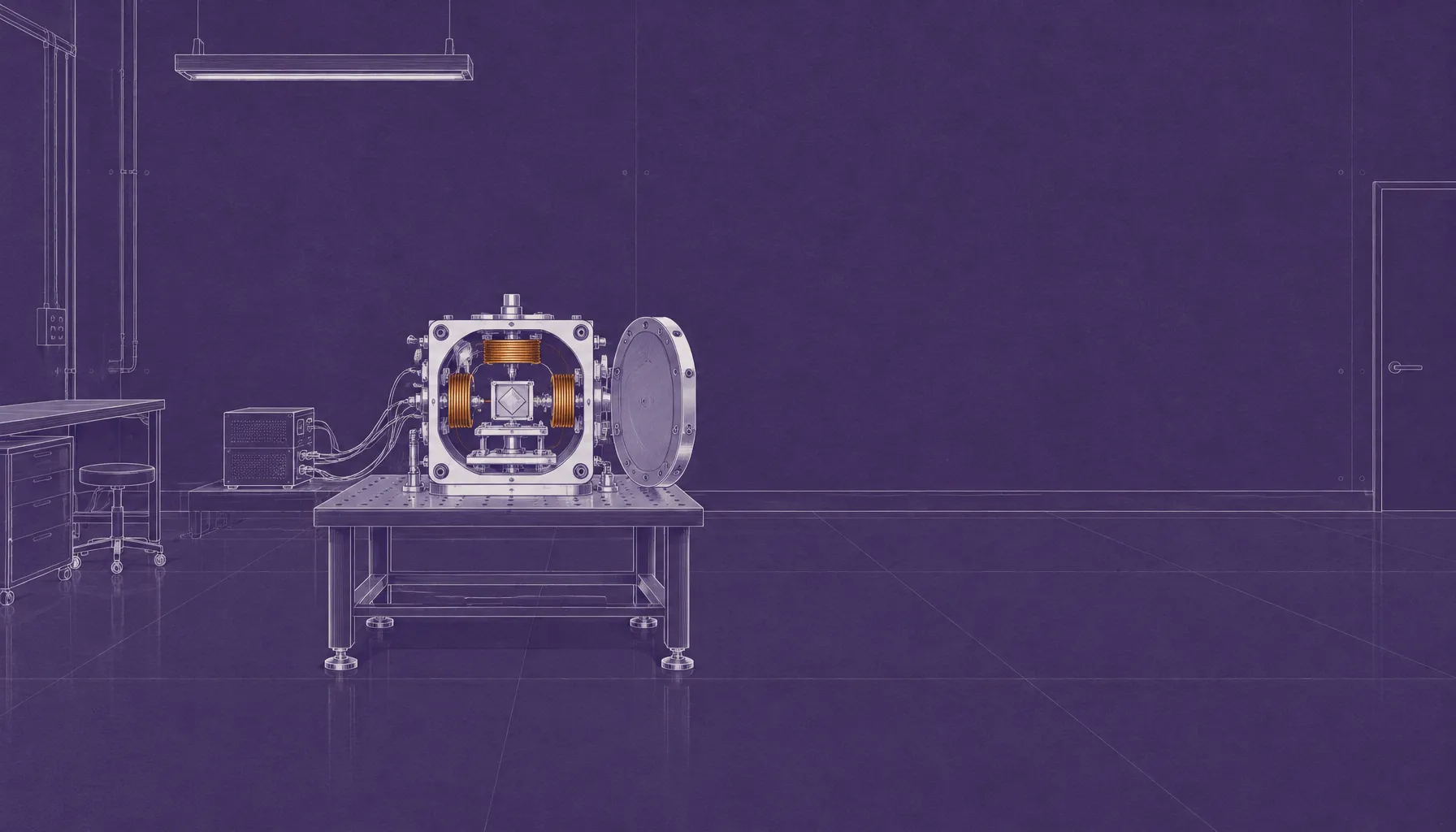
The team’s prototype uses nitrogen-vacancy (NV) centers in diamond inside a laser cavity. Rather than measuring the centers’ fluorescence, it reads the laser output; changes in magnetic field shift the NV resonances, and a microwave-driven resonance can push the laser below its operating threshold. The researchers report output power up to 50 milliwatts and a photon-shot-noise-limited sensitivity below 400 femtotesla per square-root hertz for all three field-vector components.
A magnetic resonance switches the laser off
NV centers are atomic-scale defects in diamond whose spin states respond to magnetic fields. In conventional fluorescence-based NV magnetometry, the optical contrast—the relative difference between signal levels on and off resonance—is typically only a few percent, according to Fraunhofer IAF. The laser-threshold approach instead places the diamond in the laser resonator, where the NV centers act as a magnetic-field-dependent loss channel.
When the spin resonance increases that loss enough, the laser stops emitting. “We show 100% optical contrast, i.e., we are able to entirely switch off the sensor laser system with the magnetic resonance,” the authors write. Florian Schall et al., “Laser-enhanced quantum sensing boosts sensitivity and dynamic range”
That is a contrast result, not a claim of 100% measurement accuracy. The change from laser output to no output makes the resonance easier to distinguish optically; field sensitivity still depends on the resonance width, signal noise and operating conditions.
The 590-fold figure describes a ratio
Fraunhofer IAF says the system improves by up to a factor of 590 the ratio between sensitivity and dynamic range, compared with conventional fluorescence-based NV sensors and vapor-cell magnetometers. The figure describes a comparison of two sensing metrics, not a 590-fold increase in raw sensitivity. In the paper, the authors frame the comparison against the usual sensitivity–range trade-off among the devices they evaluated.
The distinction matters because the headline numbers do not describe a single operating point. The paper reports a dynamic range of plus or minus 280 microtesla alongside a photon-shot-noise-limited sensitivity of 1,160 fT/√Hz. In a separate vector-magnetometry configuration, the team reports sensitivity below 400 fT/√Hz with a narrower range of plus or minus 40 microtesla.
The prototype still needs quieter readout
The sub-400 fT/√Hz result is a photon-shot-noise limit, not a claim that the prototype already operates at that sensitivity under real-world noise conditions. The authors describe the setup as a proof of concept and say a redesigned, more stable laser system, lock-in detection and balanced detection could bring measured sensitivity closer to that limit. Those steps are intended to reduce noise that the photon-shot-noise calculation does not capture.
Fraunhofer IAF identifies medical measurements of heart, muscle and brain activity, magnetic navigation and detection of magnetic anomalies as possible applications. The research forms part of NeuroQ, a German-funded project developing sensors intended to detect brain activity for brain-computer interfaces controlling exoskeletons. For now, the reported result is a laboratory demonstration: the laser signal can be switched off by magnetic resonance, while sensitivity and dynamic range remain dependent on how the instrument is set up.