The Signal
Electron Diffraction Tracks Tunable Decoherence Near Gold
A gold-plated microchannel lets researchers vary how strongly 1.67-keV electrons decohere near a metal surface. Their diffraction measurements show fringe visibility falling to 30–60% and match a model of quantum Brownian motion.
Quantum.world Team · Written with AI · fact-checked ·
A gold-plated microchannel drove electron diffraction fringe visibility down to 30–60%, giving researchers a measurable, adjustable signal of electrons losing coherence near a metal. The experiment, posted to arXiv on October 27, uses the changing diffraction pattern to test a long-standing account of how a metal surface can disturb an electron wave.
Wayne Cheng-Wei Huang, Zilin Chen and Herman Batelaan report that the measurements agree quantitatively with a model linking decoherence to quantum Brownian motion: the electron’s interaction with the metal’s fluctuating charges both dissipates energy and disrupts the phase relationships within its wave. “We demonstrate, for the first time, clear signatures of electron-metal decoherence and its continuous tunability,” the authors write. Wayne Cheng-Wei Huang, Zilin Chen and Herman Batelaan, authors of “Experimental evidence for quantum Brownian motion in electron-metal decoherence”
A diffraction pattern measures lost coherence
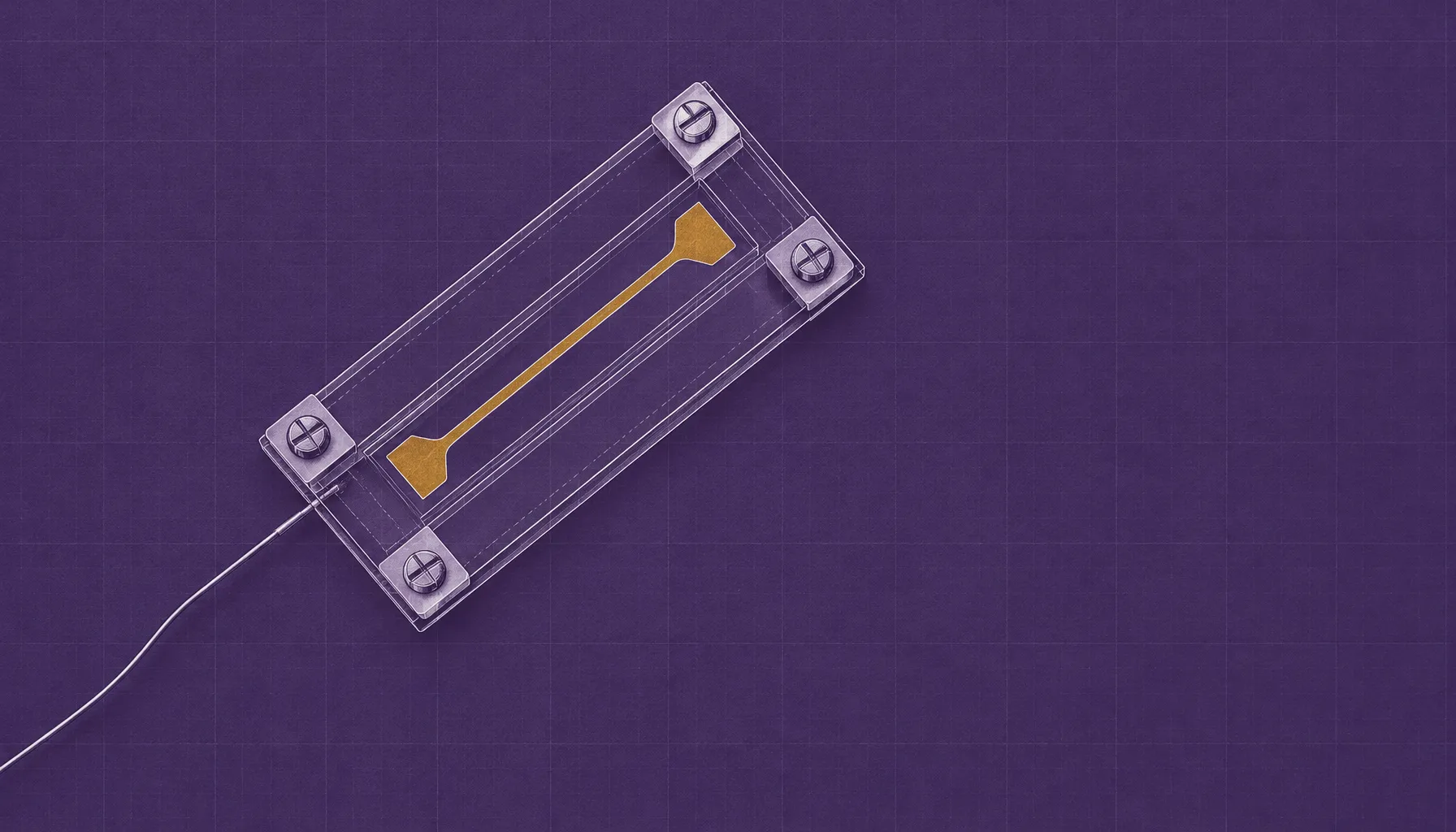
The team sent 1.67-keV electrons through a nanograting, which divided the incoming wave into diffraction orders, then directed them into a 1.7-micrometer-high microchannel. The channel’s glass walls carry sputtered gold film and are held apart by a tungsten microwire. By tilting the channel, the researchers changed the electrons’ grazing approach to the metal and the time they spent interacting with its surface.
Rather than recombining separate beams to measure interference between them, the diffractometer tracks changes within each diffraction order. Decoherence appears as a broadening of the peaks across the pattern and a decline in fringe visibility. The reference pattern, recorded without the microchannel, had 96% visibility; with the channel in the beam path, the measured visibility fell to between 30% and 60% as the tilt changed.
The tilt tests the surface-interaction model
The paper relates the decoherence rate to the electron’s distance from the gold and the duration of its interaction. At milliradian grazing angles, the electrons approach within subnanometer distances, producing a reported effective interaction strength of about 107 picoseconds per cubic micrometer. The rate generally falls as the channel tilt increases, because the electron spends less time close to the surface.
A classical calculation captures the broad trend, but the data also show a turnover near a tilt of 5 milliradians. Huang, Chen and Batelaan account for that feature with a quantum model in which incident and reflected electron waves briefly form a standing wave near the gold. Fitting the model to the measured rates gives an effective turning distance of 5.4 ångströms and a thin-film gold resistivity of 37 ± 5 nanohm-meters.
What the result does—and does not—measure
The authors frame the result as an experimental test of the Anglin-Paz-Zurek proposal, which links a charged particle’s interaction with a metal surface to dissipation and decoherence. Earlier attempts using silicon surfaces produced rates roughly two orders of magnitude below that theory’s prediction, the paper says; the present experiment instead uses gold and a near-surface geometry designed to strengthen the signal. The authors argue that the observed agreement supports quantum Brownian motion as the mechanism behind electron–metal decoherence.
The experiment does not directly measure the associated energy loss. From its parameters, the team predicts a loss between 0.67 and 6.5 electronvolts, but says testing that small change would require beam-energy fluctuations below 0.1% and an analyzer with resolution better than 10 millielectronvolts. The work is a preprint, and the authors identify direct energy-loss measurement as a separate experimental challenge.
Why the electron beam matters
Free electrons are being studied for quantum devices that use their near-field interaction with small structures, including on-chip accelerators and sources of entangled electrons and photons. Those systems can place electrons close to material surfaces, where loss of coherence may affect the quantum state delivered at the output. The paper also points to electron microscopes: if motion-related decoherence contributes to their practical resolution limits, measuring it could help clarify the source of that constraint.
For now, the central result is a controlled change in the diffraction pattern, tied to the channel’s tilt and consistent with the proposed surface-interaction model. Measuring the predicted energy loss would provide a further test of the link between dissipation and decoherence that this experiment infers from electron diffraction.