The Signal
Andreev-Qubit Proposal Uses Supercurrent to Skip Ancillas
A theoretical proposal would read an Andreev qubit from the oscillating supercurrent produced by its own quantum dynamics. The method aims to avoid auxiliary qubits and repeated resets, but the proposed device geometry has not yet been buil
Quantum.world Team · Written with AI · fact-checked ·
A current generated by the qubit becomes its readout signal
On August 5, the American Physical Society published a theoretical proposal for reading an Andreev qubit through an oscillating supercurrent generated by the qubit itself. Agência FAPESP highlighted the work on October 21. Rather than transfer information to an auxiliary qubit, the proposed setup would detect the current’s changing magnetic field and use it to infer the qubit’s state.
The paper, “Andreev qubit readout from dynamic interference supercurrent,” describes a qubit in a quantum-dot Josephson junction. Its authors write: “However, the multitude of ancilla preparations, information transfers, and ancilla measurements in these protocols create an intrinsic overhead for information processing.” Xian-Peng Zhang, Chuanchang Zeng, Zhen-Biao Yang, Jose Carlos Egues and Yugui Yao, “Andreev qubit readout from dynamic interference supercurrent”
How the oscillation carries state information
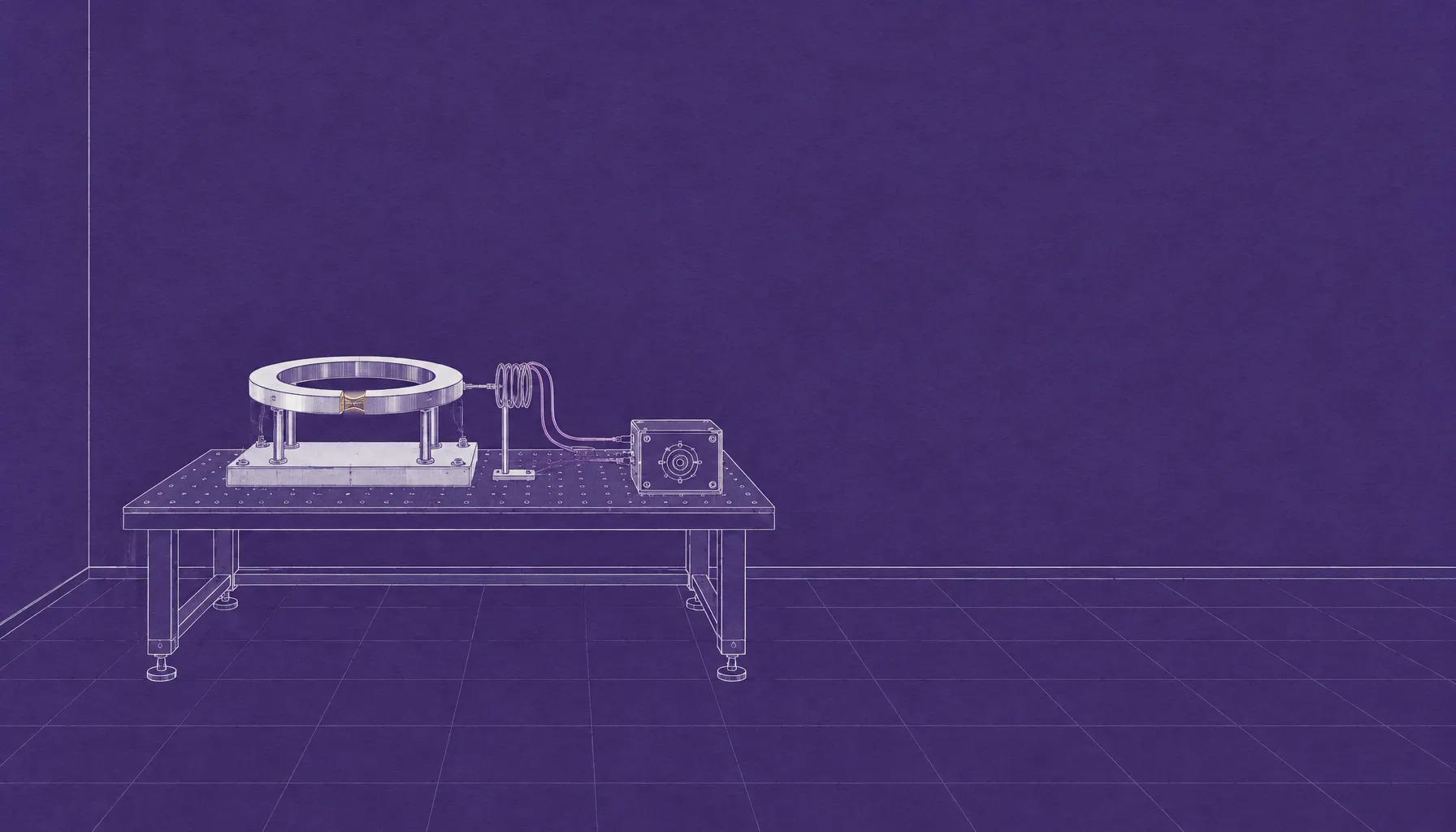
The proposed device starts with a quantum dot formed in an indium arsenide nanowire connected to superconductors. Andreev states in the junction provide the qubit’s basis states and their superpositions. When the qubit occupies a superposition, quantum interference between its states produces a time-varying component in the supercurrent, according to the paper and FAPESP’s account of the research.
The current’s steady component and oscillation amplitude indicate the relative contributions of the two basis states; the oscillation’s starting phase carries information about their relative phase. The qubit sits in a closed superconducting circuit, and a small coil coupled to a SQUID detects the magnetic signal from its current. In the proposed scheme, the current oscillates without an externally applied voltage: the qubit’s own evolution produces the signal.
Simulated readout keeps measurement backaction in view
The detector is not completely isolated from the qubit. Its coupling can feed back on the system, potentially changing the state being measured; the authors’ proposal seeks to make that effect small, not to abolish measurement backaction. Simulations included measurement noise and feedback from the detection coil, with reported accuracies of 99.52%, 99.81% and 99.85%, depending on how many measurements were considered.
Those figures come from simulations, not a laboratory demonstration. The proposal also allows measurements to be taken successively as the system evolves, without resetting the qubit to its initial state after each one. That could help track qubit dynamics while avoiding the preparation and repeated measurement steps required by ancilla-based approaches.
The proposed geometry still needs an experiment
The paper presents the method as operating within currently available experimental capabilities, and FAPESP reports that the calculations use parameters from existing systems. But the specific device geometry has not yet been built, according to José Carlos Egues, one of the paper’s authors. The authors propose detecting an Andreev qubit’s state from its own oscillating current; experimental tests of that arrangement remain ahead.
The study appeared in Physical Review B, volume 114, article L080502. Its result is a theoretical readout scheme for Andreev qubits—not a demonstrated measurement device.