The Signal
Alice & Bob’s Squeezed Cat Qubits Cut Bit Flips 160-Fold
A Nature Communications paper reports that squeezing a cat qubit extended its measured bit-flip time from 138 milliseconds to 22 seconds at the same phase-flip time. The Alice & Bob-led team also found that an error-rate floor below 10 mill
Quantum.world Team · Written with AI · fact-checked ·
Squeezing a cat qubit sharply lengthened its resistance to bit flips, but the improvement comes with a caveat: the experiment still shows a low-level error floor whose origin is unknown. In a paper published October 22 in Nature Communications, researchers led by Alice & Bob report a 160-fold increase in bit-flip time while holding the measured phase-flip time constant. The result targets a longstanding tradeoff in cat qubits: increasing photon number suppresses bit flips, but also raises phase-flip errors.
More bit-flip protection without more photons
Cat qubits encode information in two separated states of a microwave oscillator. Their separation makes bit flips less likely, while the photon loss and gain that cause phase flips rise with the average photon number. The team instead reshaped the states by squeezing them, reducing their overlap without relying on a larger photon population.
“We observe a dramatic reduction in bit-flip errors, achieving a 160-fold improvement over standard cat qubits,” write R. Rousseau and co-authors, whose affiliations include Alice & Bob and several Paris research institutions. The paper calls the deformed states “moon cats.” It reports that the measured exponential scaling factor for bit-flip suppression rose from 1.8 for standard cats to 4.3 at the strongest tested squeezing, above the paper’s cited limit of 2 for standard dissipative cat qubits.
22 seconds against the standard cat’s 138 milliseconds
The headline comparison holds phase-flip time at 1.3 microseconds for both devices. The standard cat, with an average of 4.9 photons, had a bit-flip time of 138 milliseconds; the squeezed moon cat, with 4.1 photons, reached 22 seconds. The team sets the comparison at equal phase-flip time, rather than equal photon number, to show the change in bit-flip protection without accepting a worse measured phase-flip lifetime.
The researchers measured the decay of the encoded qubit’s logical states after idle periods. Because the squeezed device’s bit-flip time spans seconds, they sampled the wait times adaptively, using a Bayesian method to direct measurements toward the most informative times. The work extends a result first circulated as a preprint and now appears in the journal under the title “Enhancing bosonic qubit protection by squeezing.”
A pump changes the state, not the circuit design
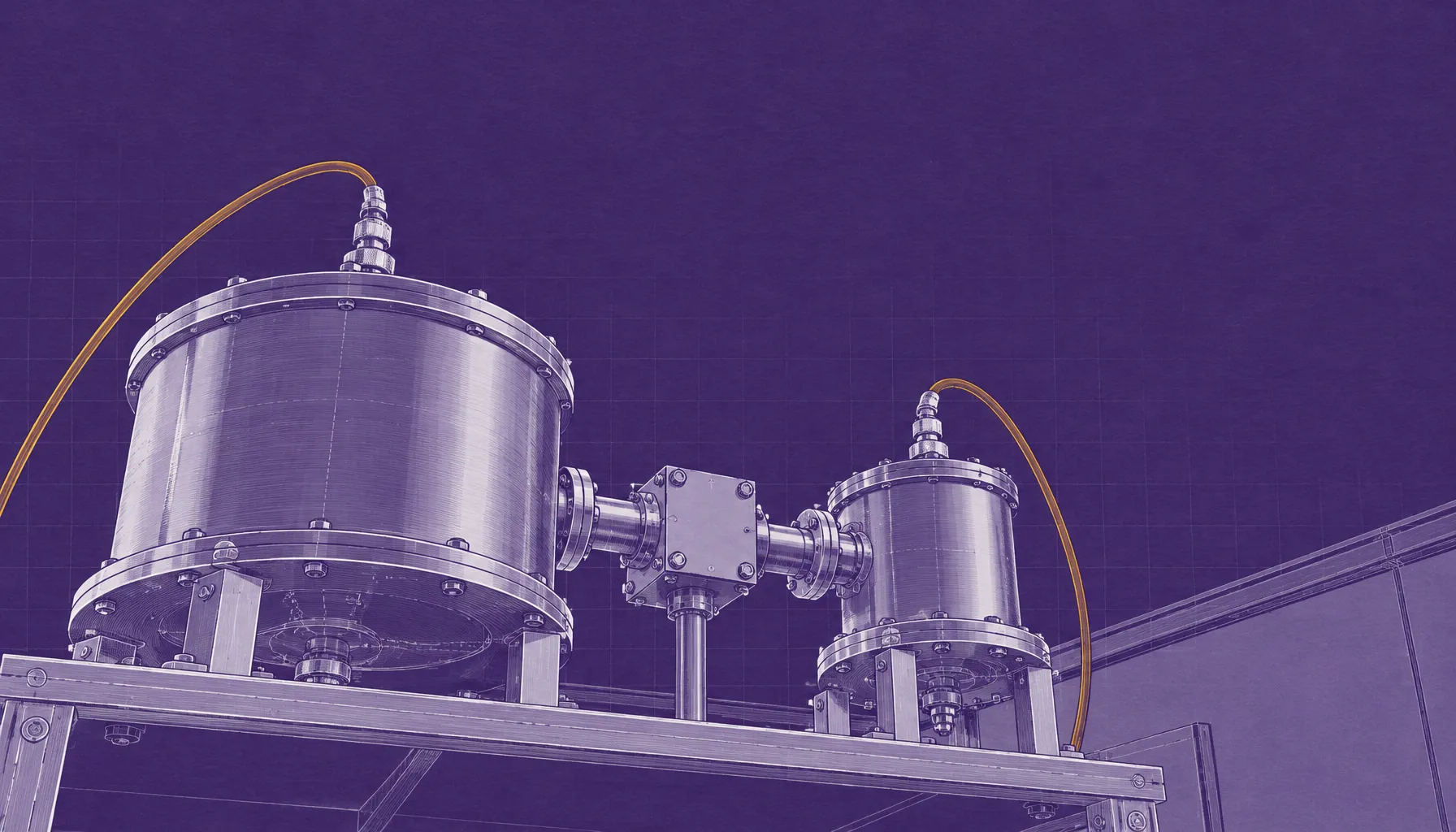
The experiment uses a superconducting circuit with a high-quality memory mode coupled to a lower-quality buffer mode through a nonlinear element. Several pump processes stabilize the cat states; an additional longitudinal pump supplies the interaction that deforms them. The paper says that adding this interaction required no circuit-design change from the standard cat-qubit setup.
That does not mean the squeezing pump is cost-free. The authors report that the effective phase-flip rate rises as they increase the deformation, likely because of heating or spurious processes induced by the pumps. At the strongest tested deformation, the effective rate increases by a further factor of 1.4, yet the matched-phase-flip comparison still delivers the large bit-flip-time gain.
The gain carries into a Z gate, with limits
The paper also tests a Z gate, which rotates the encoded state while strong stabilization keeps the cat states confined. For the compared operating points, the squeezed cat’s optimal gate runs 1.6 times faster and has a 1.5-fold lower phase-flip probability. The authors estimate a 220-fold improvement in bit-flip probability during the gate, combining stronger idle protection with the shorter gate and less severe error growth during the drive.
A separate limitation appears at very low bit-flip rates: the team observes saturation below 10 millihertz, with little dependence on squeezing. The paper says the cause is not understood and suggests ionizing impacts that disrupt superconductivity as one possible explanation. The experiment therefore establishes a stronger single-cat protection technique, while leaving both that error floor and the move to a multi-cat fault-tolerant architecture unresolved.
The study lists financial interests for Alice & Bob-affiliated authors and identifies Zaki Leghtas as a shareholder; the remaining authors declare no competing interests. Its immediate quantitative result is specific: at the same 1.3-microsecond phase-flip time, the measured bit-flip time rises from 138 milliseconds to 22 seconds.