The Signal
Aarhus Spectrometer Learns DNP Pulses on the Sample
Aarhus researchers used Bayesian optimization to design dynamic nuclear polarization pulse sequences by testing them directly on samples in a spectrometer. The method produced results comparable to an established sequence in a trityl test a
Quantum.world Team · Written with AI · fact-checked ·
“For trityl and nitroxide samples, it is demonstrated that efficient broadband DNP pulse sequences can be designed in situ with experimental protocols benchmarked against in silico analogs.”
The authors write in the abstract of their Science Advances paper.
“What is new is that we let the spectrometer itself learn how to perform the best experiments. We do this using AI,”
says Filip V. Jensen, PhD student and first author of the study.
Aarhus puts the sample inside the control loop
Aarhus University researchers have trained a magnetic-resonance spectrometer to improve its own microwave pulse sequences by testing them on the sample rather than relying solely on advance calculations. The university described the work on October 27, 2026; the study was published in Science Advances on September 18, 2026. Its focus is pulsed dynamic nuclear polarization (DNP), a technique that transfers polarization from electron spins to nearby nuclear spins to strengthen signals used in nuclear magnetic resonance (NMR).
Designing pulses for these experiments can be difficult because an electron may interact with hundreds or thousands of nuclei. The resulting spin system, along with imperfections in the instrument, can exceed what conventional numerical pulse-design methods handle well. Instead, the Aarhus team measures the sample’s response and uses that signal to guide the next pulse sequence.
Bayesian optimization proposes each next pulse
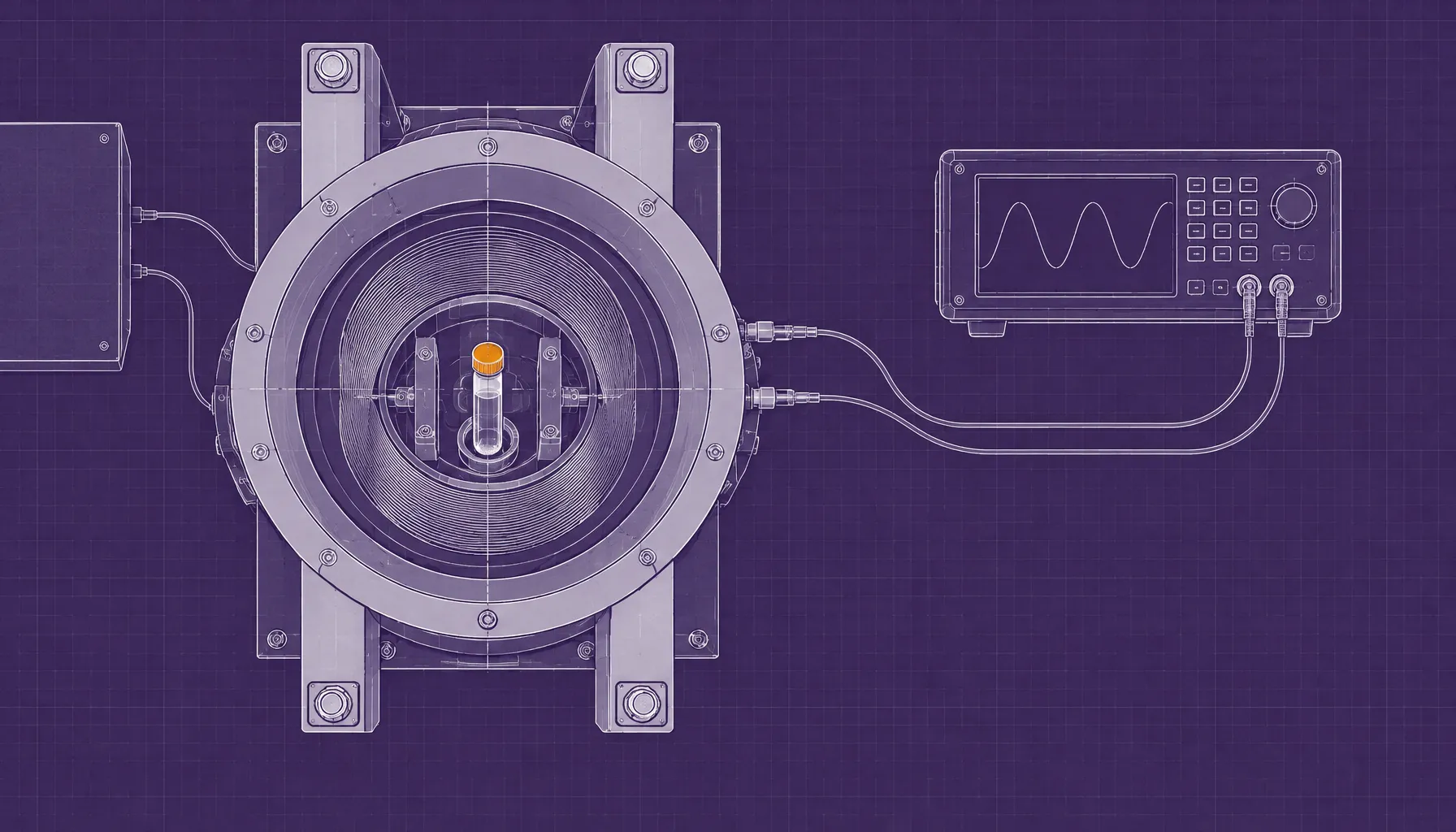
The researchers connected a Bayesian optimization algorithm to a home-built X-band pulsed DNP/EPR spectrometer. The algorithm proposes pulse settings, the instrument runs them on the sample, and the measured signal becomes feedback for the next proposal. The team also tested a constrained version of the search, using resonance conditions to narrow the pulse settings the algorithm explores.
The measurements used frozen samples at 80 kelvin: trityl OX063 and the nitroxide radical 4-Oxo-TEMPO. The system optimizes the DNP transfer step, measuring how well microwave pulses move polarization from electron spins to surrounding protons. The researchers choose the variables and constraints, and the method uses feedback from the spectrometer-and-sample system.
Trityl results came close to a leading sequence
For trityl OX063, the team compared a Bayesian-designed 24-pulse sequence with three established pulse approaches. Across electron-spin offsets from minus 60 to plus 60 megahertz, the new sequence produced an average enhancement of 96 after a 64-second buildup. The benchmark cRW-OPT1 sequence averaged 98 under the same comparison, while PLATO averaged 69 and NOVEL 35.
The near-match with cRW-OPT1 matters because that sequence was designed using analytical and numerical methods for the well-characterized trityl system. Aarhus’s result shows that the spectrometer-led procedure can reach comparable performance in that test; it does not show that the learned sequence outperforms the best existing method. The authors treat the trityl experiments as a proof of concept for applying the approach to systems whose spin behavior is less well known.
The 70% gain came with limits
In a second test, Bayesian optimization produced a 70% sensitivity gain over a spin-lock reference in a 2-millimolar 4-Oxo-TEMPO sample. The paper describes the reference as a spin-lock sequence and notes that its microwave amplitude exceeded the standard NOVEL condition, although the authors report similar efficiency at the true NOVEL setting. The broadband pulse sequences did not outperform the spin-lock sequence in this nitroxide experiment.
The authors also caution that overall transfer efficiencies in the nitroxide test were not impressive. They deliberately used a low concentration to examine solid-effect DNP, rather than the higher concentrations typically associated with cross-effect DNP. The 70% result is an improvement within a specific experiment, not evidence that the method has solved sensitivity limits across NMR.
What the test establishes—and what it does not
DNP can raise NMR sensitivity substantially in suitable systems, but pulse design must account for interactions and hardware behavior that may not be fully captured in a model. The Aarhus method uses the actual instrument-and-sample combination as its test environment, letting measured outcomes steer the search. The study also points to possible uses in other magnetic-resonance work and electron-spin quantum sensing; those applications are prospects rather than demonstrated results.
For now, the strongest evidence is the direct comparison: a learned trityl sequence averaged 96 against 98 for cRW-OPT1, while the 70% nitroxide gain came with low overall transfer efficiency and a reference-setting caveat. The results show that in situ optimization can serve as an experimental design tool, without establishing it as a replacement for existing pulse sequences or a general guarantee of better signal.