The Signal
125-Qubit Processor Teleports Surface-Code States at Distance Seven
A superconducting processor with 125 qubits demonstrated teleportation of surface-code states at code distance seven, using 98 qubits in two interlaced blocks. Because hardware feedback was unavailable, the researchers postponed Alice’s mea
Quantum.world Team · Written with AI · fact-checked ·
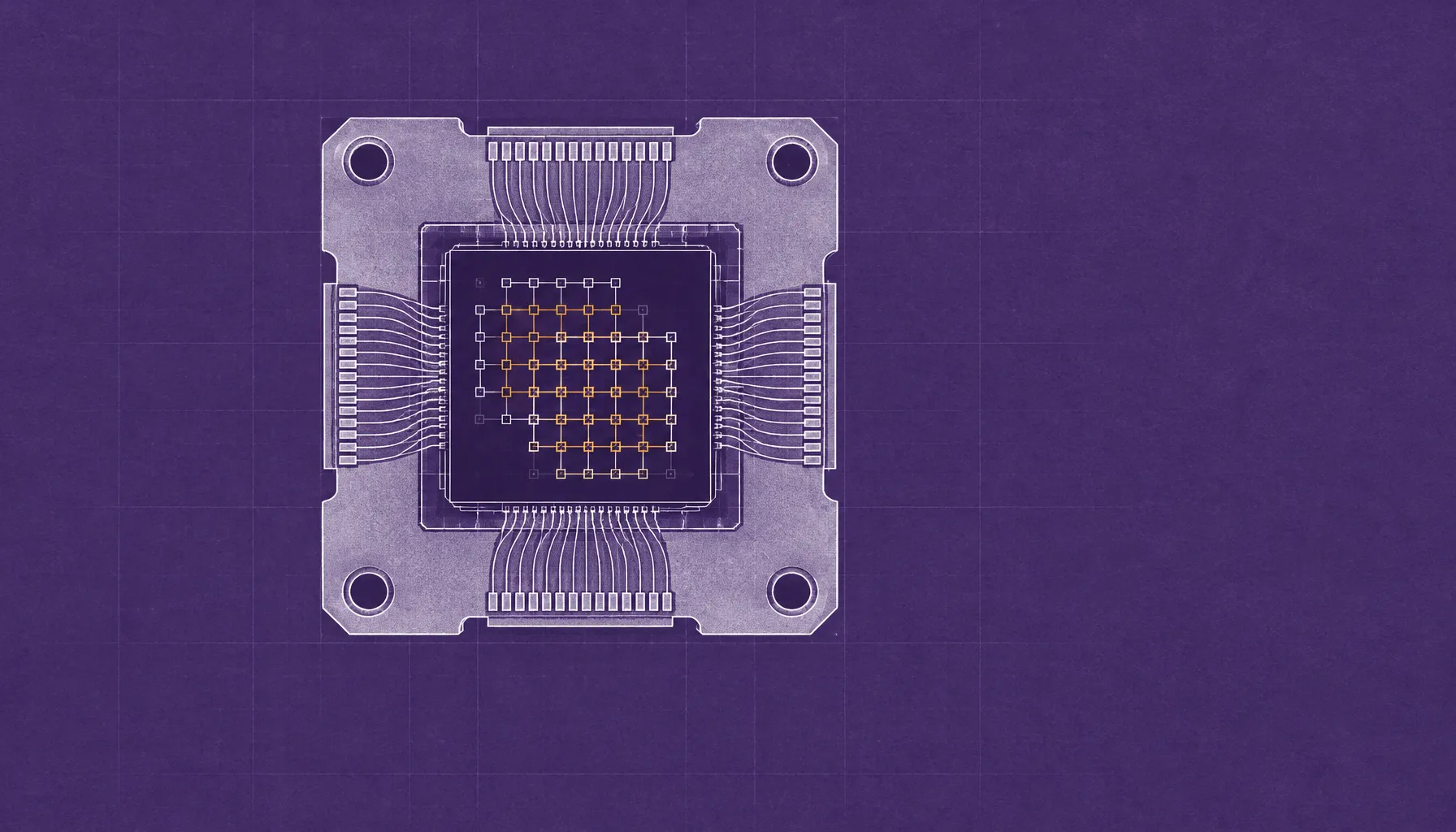
A 125-qubit superconducting processor has teleported encoded surface-code states at code distance seven, using 98 qubits arranged as two interlaced 49-qubit blocks. The result, published in Nature Physics on October 22, demonstrates logical-state transfer across a larger code than previous experiments in this study’s approach. It does not mean a quantum state traveled seven physical steps or between distant machines: “distance seven” describes the code’s error-protection scale, and both blocks sit on the same processor.
Two code blocks, one processor
The team prepared a logical state in one surface-code block, called Alice, while the second block, Bob, began in a simple product state. Transversal entangling gates coupled corresponding qubits across the two interlaced grids. In a standard teleportation sequence, Alice’s measurement outcomes would guide operations on Bob. But hardware feedback was unavailable: the team postponed Alice’s measurement and applied a layer of CNOT gates beforehand to replace classical communication. The final logical information was retrieved from Bob using a decoder.
That setup distinguishes the work from demonstrations that transfer a logical qubit between blocks already encoded on both sides. Here, the state moves along with the collective pattern of entanglement that defines the surface code.
“The slight increase in the logical error rate can be attributed to the additional errors introduced by the teleportation circuit.”
Yiren Zou et al., authors of the study, write in the paper.
Teleportation adds a measurable error cost
At the largest code distance, the team reports a logical error rate of 0.014(1) for Alice’s prepared state and 0.025(3) for Bob’s teleported state. The increase shows that transfer adds noise, even as the decoded logical state remains recoverable under the experiment’s operating conditions. The processor’s median single-qubit gate fidelity was 99.94%, its two-qubit gate fidelity 99.64%, and its readout fidelity 99.08%.
The researchers also tested a family of logical states at distance three, including an H-type magic state, a resource used in universal quantum computing. Average state fidelity was 0.96(1) before transfer and 0.95(2) afterward. Those fidelity figures apply to the distance-three state tests, not to the distance-seven logical-error measurements.
Noise changes the transfer threshold
Beyond testing transfer at one operating point, the team tuned the entangling gates to introduce controlled coherent errors and mapped where logical information remained recoverable. For an error axis along X, the measured finite-size pseudo-threshold was 0.122(2)π; rotating the axis toward X+Z raised it to 0.175(5)π. These are experimentally extracted thresholds for the tested circuits, not a general error-rate guarantee for a deployed quantum computer.
Under a separate model of independent bit-flip noise, the paper gives a critical probability of 0.109. The study also identifies a limitation in its decoding: it uses only one type of syndrome information, which leaves its decoding threshold below the higher threshold associated with the full coherent-information analysis. The magic-state preparation in the experiments also uses a non-fault-tolerant injection method.
The distance between processors remains untested
The distance-seven transfer took place inside one flip-chip processor, with Alice and Bob physically interlaced to make the coupling practical. The authors say that fast mid-circuit measurement and efficient qubit reset could reduce state-preparation circuit depth and allow adaptive noise suppression before and after transfer. Their next stated challenge is to extend the protocol across separate superconducting processors, where weaker entanglement over a physical link would test whether the logical transfer can withstand communication noise.
For now, the concrete result is a teleported distance-seven code on one chip: 98 qubits in two blocks, with the decoded logical error rising from 0.014(1) before transfer to 0.025(3) afterward.