The Signal
Tanay Roy’s Protocol Lets a Quantum Gate Wait for Its Recipient
Tanay Roy describes a quantum protocol that distributes encoded shares to candidate nodes before a recipient is chosen. A later release of a key register lets the selected node complete a gate with the user, while the other nodes remain una
Quantum.world Team · Written with AI · fact-checked ·
Quantum gate teleportation usually fixes the destination before the entangled resource is distributed. Tanay Roy’s new protocol separates those steps: it sends encoded shares to candidate nodes first, then lets a later key release select which one can use the gate. In a paper dated October 30, 2026, Roy describes a scheme designed to keep the unselected nodes unaware of both the user’s data and whether a recipient has been chosen.
A gate resource without a fixed destination
In ordinary gate teleportation, an entangled resource carries a particular operation to a destination node. Roy identifies that advance commitment as a problem for distributed systems where the destination should remain undecided until after the resource has been placed. The paper describes two approaches to deferring the choice. In one, the provider shares a Bell pair with the user and later swaps its half onto the selected node, but the provider making the choice already holds a usable gate. A GHZ-based scheme requires every candidate to participate, so any one of them can veto the gate.
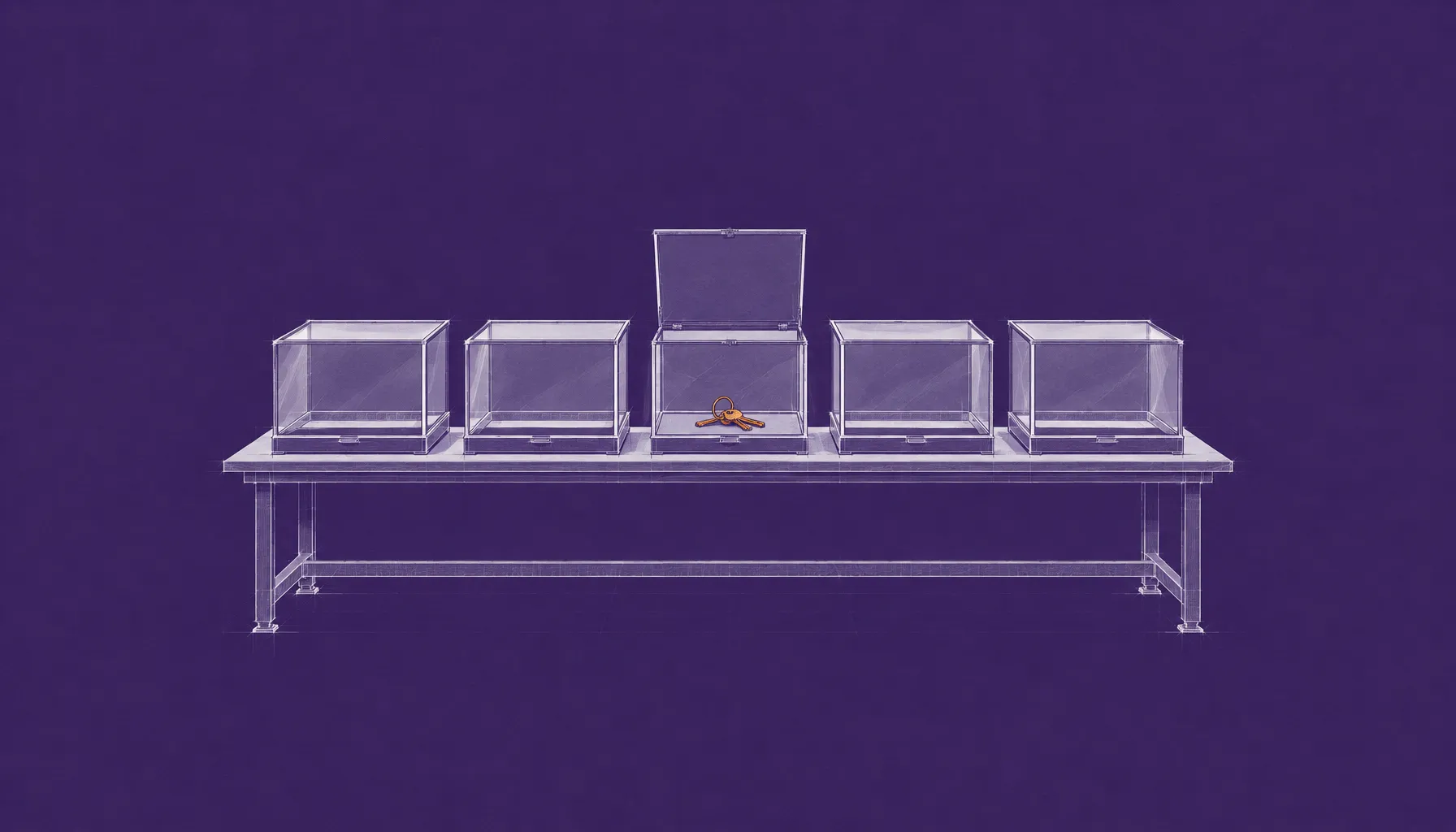
Roy’s proposed alternative encodes one half of a Bell pair into n signal qudits, one for each candidate site. The provider holds a corresponding register of key qudits and releases the full register to one site only after distribution.
“Here we show that the capability to apply a two-qudit entangling gate can instead be secret-shared among many parties: the shares are distributed in advance, and a later key release lets exactly one of them, chosen after distribution, exercise it.” Tanay Roy, author of the paper, writes.
Local operations complete the remote gate
Once the selected node receives the key register, it uses a decoder with its own signal qudit to recover a Bell-pair resource with the user. The user and recipient then apply local operations to their separate data qudits, measure their parts of the resource, exchange two classical dits and apply corrections. The protocol produces an exact non-local controlled-sum gate, written CSUM, in every measurement branch; the data qudits do not interact directly.
The construction works for any qudit dimension and lets the user determine the gate’s power without revealing that choice in the transmitted registers or public messages. Roy gives explicit encoder and decoder circuits whose gate counts scale as O(n) and do not depend on the qudit dimension. For two candidates, five registers form a ((3,5)) threshold scheme under the paper’s stated phase-angle condition: any three can recover the secret, while any two can be lost or intercepted without leaking information or destroying the gate. At the smallest flat phase angle, this threshold property holds when the dimension is not divisible by 7. For dimension 7, the paper gives another flat angle, 4π/7, that restores the threshold property.
Privacy depends on the key and the provider
Unselected signal shares remain maximally mixed, including when all non-recipients pool their qudits, according to the paper. Those nodes cannot distinguish a run in which another site was selected from one in which no selection occurred. The key register alone also carries no information, and the key cannot be used a second time to redeem the resource.
The protocol’s guarantees come with operational and trust conditions. Roy assumes the provider follows the protocol and knows the recipient; candidate sites may collude and inspect their shares but do not deviate from the protocol. The key register must reach the chosen node intact over an authenticated quantum channel, and a site that obtains it could redeem the gate in the recipient’s place.
A theoretical protocol, not a network demonstration
The paper presents a mathematical construction and explicit circuits, not an experimental demonstration on a quantum network. Its claims of exact operation assume ideal gates, intact delivery of the key register and faithful exchange of the measurement outcomes. The distinction matters: the result establishes how delayed selection could work within the stated model, but does not report measured performance on hardware.
For the protocol’s final gate operation, the user and selected node exchange two classical dits; the key register itself must travel intact to that node over an authenticated quantum channel.